Tire Tread Wear Bars: How Do You Read Them?

Tire tread wear bars tell you to replace a tire when the bars sit flush with the tread at the shallowest point on the tire, or when your gauge reads 2/32 inch there. Ignoring the lowest reading can leave you with a tire that looks fine in one groove but loses wet grip and may fail inspection. This article shows how to read the bars, confirm flushness, and judge uneven wear across all grooves.
What tread wear bars mean
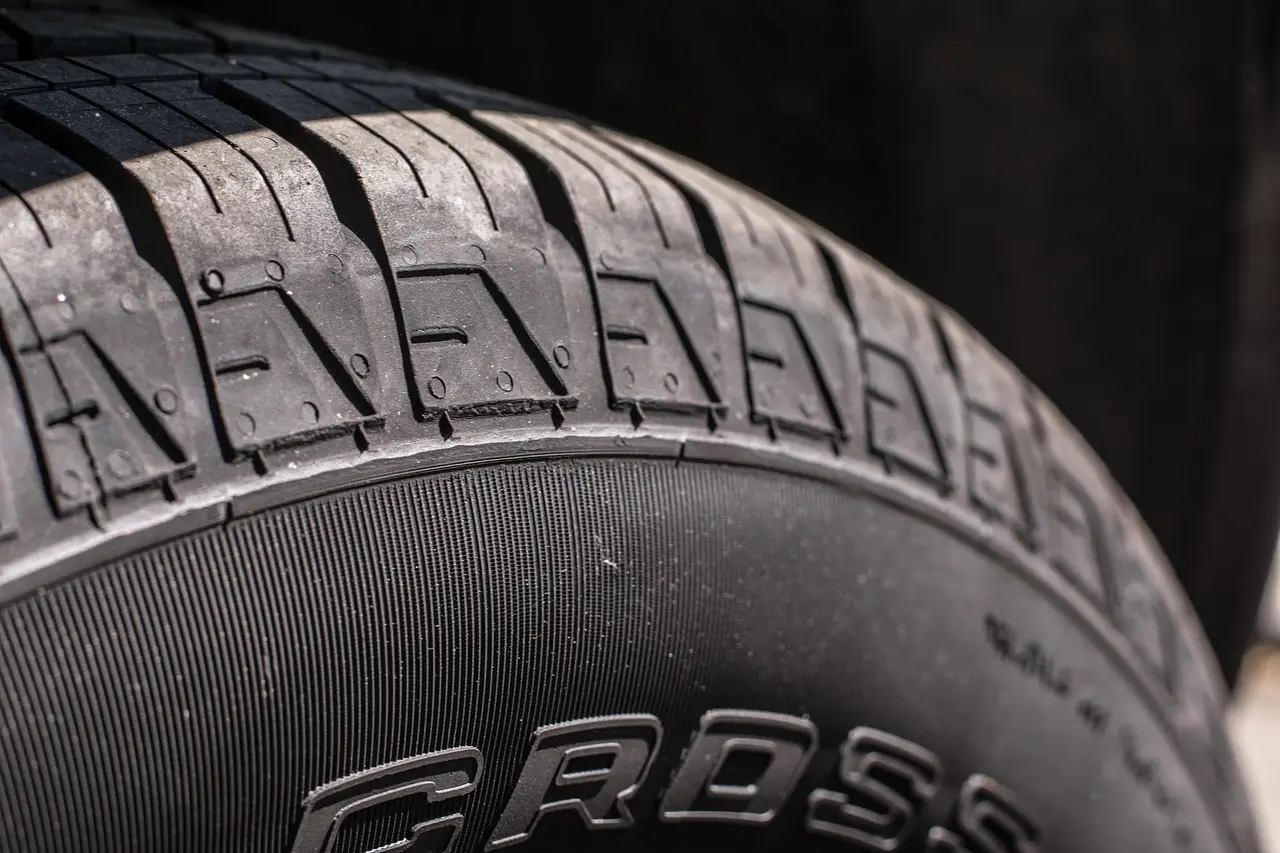
Tread wear bars are molded rubber indicators in the grooves. They mark the minimum allowable tread depth. When tread reaches those bars, the tire is at or near the replacement point, and visible or flush bars mean you should plan on replacement soon or right away depending on what else you see.
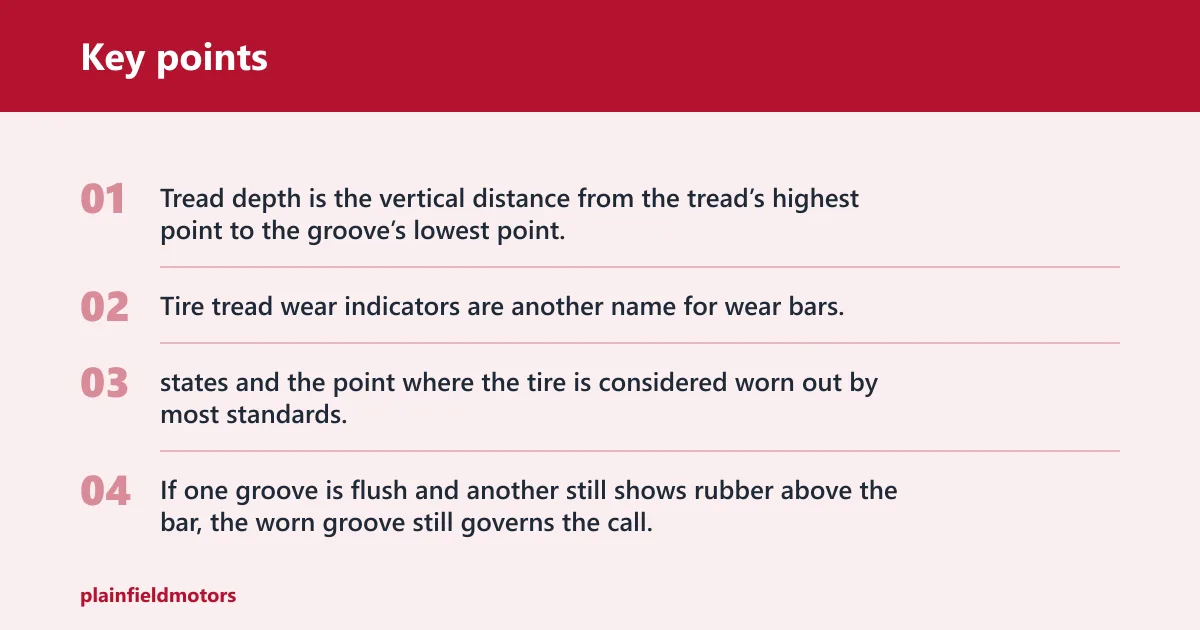
Tread depth is the vertical distance from the tread’s highest point to the groove’s lowest point. It is measured in 32nds of an inch, and it varies by location around the tire. That variation matters because the shallowest groove is the one that tells you the real condition of the tire.
Tire tread wear indicators and 2/32 inch
Tire tread wear indicators are another name for wear bars. They appear at 2/32 of an inch, which is also the common legal minimum in U.S. states and the point where the tire is considered worn out by most standards. Pirelli says the bars sit 2/32 inches above the lowest groove point, and if the tire is flush with any indicator bar, replace it.
That does not mean every groove must look identical. It means the lowest groove, at the deepest wear point, sets the decision. If one groove is flush and another still shows rubber above the bar, the worn groove still governs the call.
How do you read tread wear bars?
Read tread wear bars by comparing the bar to the tread blocks around it, then checking the same tire in several places. Hidden bars mean usable depth remains. Barely visible bars mean the tire is approaching the limit. Flush bars, especially at the shallowest point, mean it is time to replace the tire.
Hidden bars
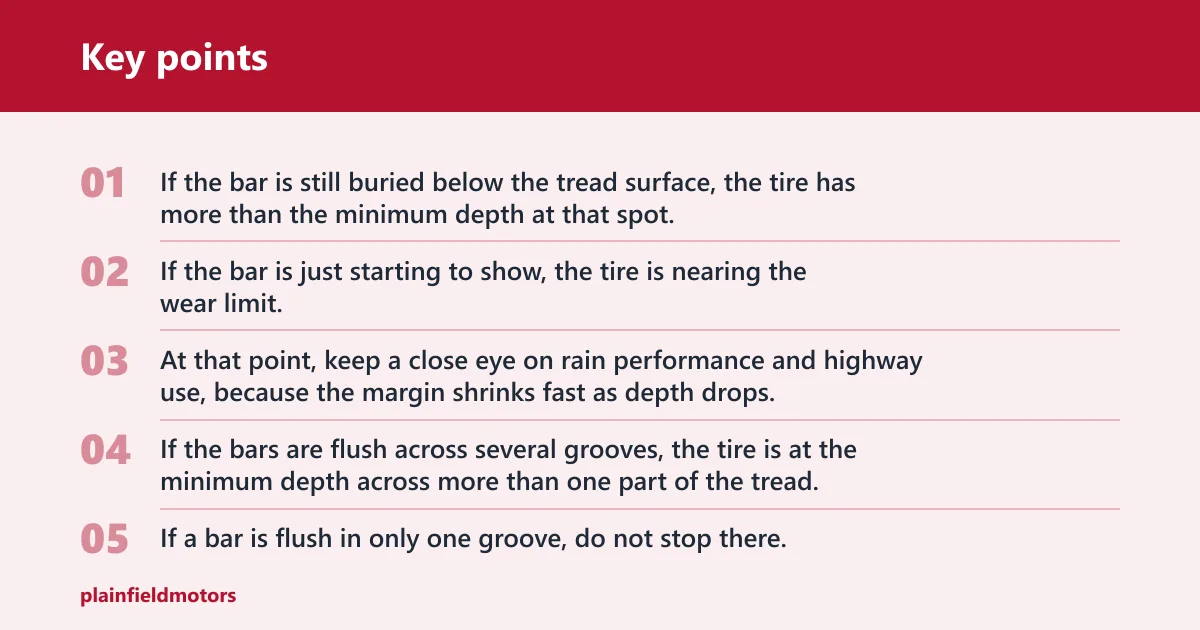
If the bar is still buried below the tread surface, the tire has more than the minimum depth at that spot. That is only one point of one groove, though. You still need to check the rest of the circumference and the other grooves, because a tire can be deeper in one place and thin in another.
Barely visible bars
If the bar is just starting to show, the tire is nearing the wear limit. At that point, keep a close eye on rain performance and highway use, because the margin shrinks fast as depth drops. Kal Tire says 4/32 to 3/32 inches is a sensible replacement range, and 5/32 inches is already a concern if wet roads matter.
Flush bars across multiple grooves
If the bars are flush across several grooves, the tire is at the minimum depth across more than one part of the tread. That is a strong replacement signal. A tire in that condition has little reserve for wet-road traction, and it is much closer to legal minimum than a tire with bars still hidden.
Flush bars in one groove only
If a bar is flush in only one groove, do not stop there. That usually means the tire is unevenly worn, and the shallowest groove is already at the limit even if the rest of the tread looks better. The lowest reading wins, because hydroplaning resistance and stopping power depend on the least tread, not the average tread.
| What you see | What it means | What to do next |
|---|---|---|
| Bars hidden below the tread | That groove still has usable depth above 2/32 inch. | Keep driving, but check the rest of the tire in several places. |
| Bars barely visible | The tire is nearing the minimum and may be in the 4/32 to 3/32 range. | Plan replacement soon, especially if you drive in rain. |
| Bars flush in one groove only | The tire is unevenly worn, and the shallowest groove has reached the limit. | Use the lowest reading as the decision point and inspect for alignment or inflation issues. |
| Bars flush across multiple grooves | The tire is at the minimum across most of the tread. | Replace the tire right away or very soon. |
| Bars plus uneven shoulder wear | The tire shows wear and a pattern problem, not just simple age. | Replace if needed, and check pressure, alignment, rotation history, and suspension wear. |
How do you check tread depth at home?
You can check tread depth at home with a penny test, a quarter test, or a tread depth gauge. The penny test is only a quick screen. The gauge is the most accurate home method because it gives a direct reading in 32nds of an inch, which is what you need for a real decision.
Use the penny test. Place Lincoln’s head into the groove with his head facing down. If all of Lincoln’s head is visible, the tire is at about 2/32 inch and should be replaced. This is a quick check, not a precision measurement.
Try the quarter test. Insert a quarter into the tread with George Washington’s head facing down. If the top of his head is visible, the tire is around 4/32 inch, which many experts commonly treat as a replace-soon point for wet-road safety. That makes it more useful than the penny test when you want an earlier warning.
Measure with a gauge. Press a tread depth gauge into the groove and read the lowest groove on the tire in 32nds of an inch or millimeters. Check the shallowest groove around the tire, because that reading should drive your decision.
The front tire in the example may show about 5/32 in one groove and about 2/32 in another. The quarter test may still look acceptable in the deeper groove, but the gauge will reveal the real problem: the tire is already at the replacement threshold at the shallow point. That is why a single spot can mislead you.
Why the shallowest groove matters
The shallowest groove matters because tread depth varies by location around the tire. You should check multiple points around the circumference and use the lowest reading as the decision point. The same source says to check tread depth at various points around the circumference, and that is the right habit for spotting uneven wear before it becomes obvious.
Uneven shoulder wear matters too. If the shoulders are worn lower than the center, the tire may still have visible tread in the middle but be near the limit at the edge. That points to inflation, alignment, rotation, or load issues, not just normal wear.
Check all four quadrants. Measure or inspect the tire at several points around its face, not just one spot that looks convenient. A tire can show different readings after cornering wear, underinflation, or misalignment.
Compare the shoulders. Look at both outer shoulders and the center tread. If one shoulder is much lower, treat that tire as worn to the shallowest point and inspect the vehicle for a cause.
Use the lowest reading. Make your decision from the smallest tread depth you find. That is the point most likely to lose wet traction first.
Can you keep driving on visible wear bars?
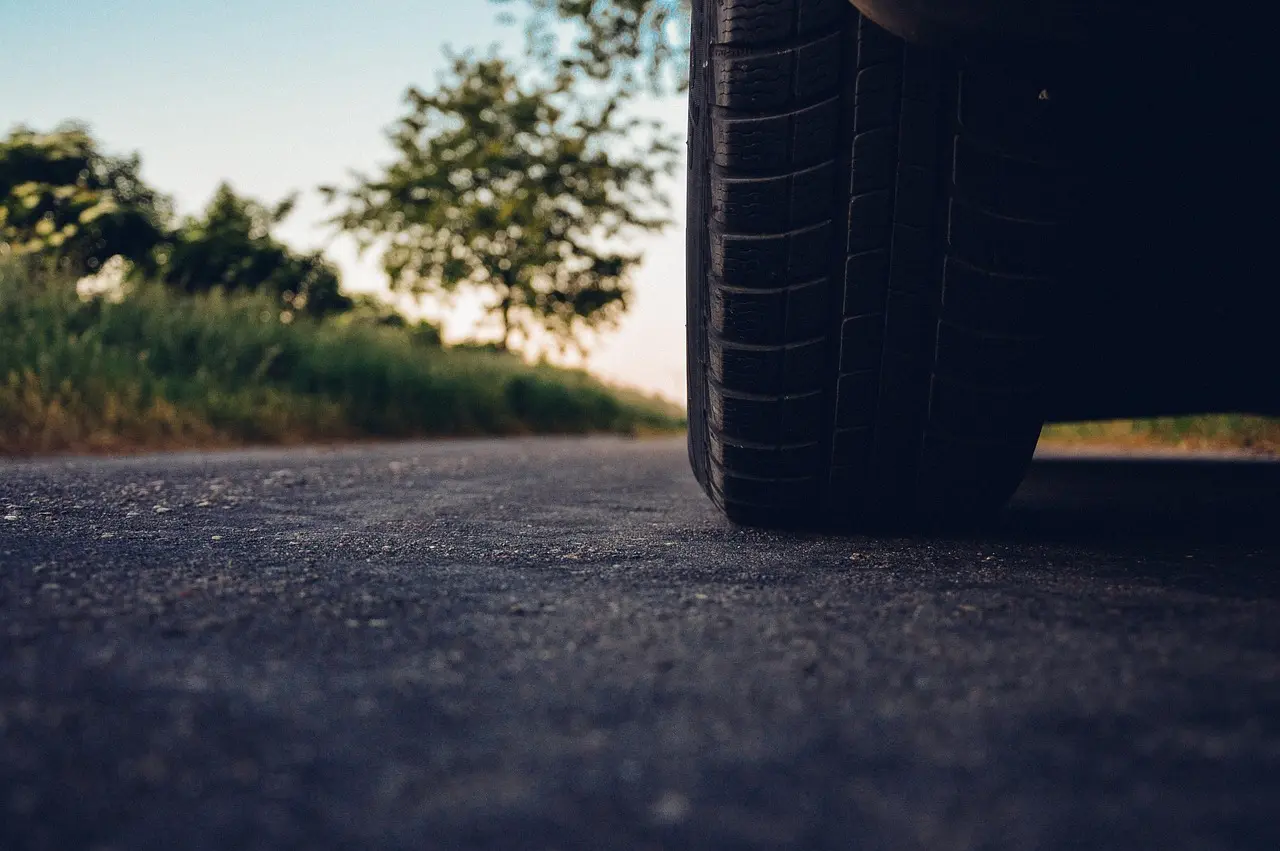
Visible wear bars mean the tire is at or near the legal minimum, so the safe answer is usually no for long. If the bars are flush, the tire is at 2/32 inch and should be replaced right away. If the tread is only slightly above that point, many drivers should still replace soon, especially if rain, standing water, or highway speeds are part of normal use.
A common rule of thumb is that about 4/32 inch is a replace-soon point, while 2/32 inch is the legal minimum in many places. 4/32 inch is a common expert replace-soon point, while 2/32 inch is the legal minimum in most states. Waiting for the last 2/32 inch leaves very little margin for water evacuation, and that is where hydroplaning risk rises fast.
Suppose one rear tire has 6/32 inch in the center but only 2/32 inch on the outer shoulder. The tire is not “mostly fine.” The shoulder reading controls the call, because that is the shallowest point and the first place the tire may lose grip in rain.
When one tire wears faster than the others
If one tire hits the bars earlier than the others, you do not automatically need all four tires at once. First, compare the remaining tires by axle and by depth. If two tires on the same axle are close in tread depth, replacing that pair keeps balance more even. If the others are still well above the wear limit, they may be left in service.
What matters most is matching depth on the same axle and avoiding a mix of very worn and much deeper tread on the same end of the vehicle. If the wear pattern is uneven, the vehicle may also need an alignment check or pressure correction before the next set of tires wears the same way.
What to inspect along with tread wear
Inspect tread, but do not stop there. Look for cracks, cuts, bulges, and uneven wear while you check the bars. A tire with visible bars and sidewall damage needs attention faster than a tire that is only worn low.
Uneven wear patterns matter because they can explain why one groove shows the bar early. Cupping, shoulder wear, and center wear all point to different causes. Fixing the cause helps the next set of tires last longer and wear more evenly.
Practical reading sequence
Find the wear bars. Look inside the grooves for the small raised rubber bridges that run between tread blocks. Those are the visual indicators that mark the minimum depth.
Check every groove. Compare each groove to its bar and note where the bar is hidden, barely visible, or flush. The shallowest groove gives the correct answer.
Measure the lowest point. Confirm your visual check with a gauge and record the smallest number around the tire. Use that number to decide whether the tire is ready for replacement.
Frequently asked questions
How do I read tire tread wear bars?
Read them by looking for the bar in the groove and comparing it to the tread around it. Hidden bars mean the tire still has depth there. Barely visible or flush bars mean the tire is nearing or at the replacement point, and the shallowest groove should decide the outcome.
How do you tell if tread wear bars are flush with the tire?
The bar is flush when it sits level with the surrounding tread blocks and no longer looks recessed in the groove. Check more than one groove and more than one spot around the tire. If any indicator bar is flush at the shallowest point, replace the tire.
Are tread wear bars the same as tire wear indicator bars?
Yes. Tread wear bars and tire tread wear indicators are the same thing in ordinary use. They are molded into the grooves to mark the minimum allowable tread depth, and they appear at 2/32 of an inch. Different brands may use slightly different wording, but the function is the same.
What does it mean when the tread wear bars are showing?
Showing bars mean the tire is close to, or already at, the minimum tread depth. If they are just starting to appear, plan replacement soon. If they are flush, the tire is at the limit and should be replaced right away, especially if the road is often wet.
Can I still drive if the wear bars are visible?
You may be able to drive short distances, but visible bars mean the tire has little tread left. That raises hydroplaning risk and reduces stopping power, especially in rain. Replace the tire as soon as practical, and do not rely on visible bars for long-term use.
Do I need to replace all four tires if one tire hits the wear bars?
Not automatically. Replace the worn tire or the axle pair if the remaining tire on that axle is close in depth. If the other tires still have much more tread, they may remain in service. Match depth on each axle and inspect for the cause of the early wear.