How to Tell If Your Tires Need Rotating

Rotate your tires if the front and rear tires show uneven wear, if steering-wheel vibration or pulling appears, or if tread depth differs by about 2/32 inch or more across positions. Waiting can shorten tire life, reduce wet grip, and turn a low-cost rotation into an early replacement. This guide shows how to compare wear patterns, check tread depth, and decide whether rotation is due now.
Signs your tires need rotation
The quickest check is simple: compare all four tires, look for a larger wear gap front to rear, and note any vibration or pull that started after the last service. Rotation is usually due when wear is uneven but still even enough that a standard rotation can help; deeper scrub wear or a crooked pull points to a separate problem.
Uneven wear at a glance
Front and rear tires rarely wear at the same rate. Front tires often wear faster on many cars because they steer, brake, and carry power; rear tires can also wear faster on rear-drive vehicles under acceleration. If one axle is clearly more worn than the other, rotation is likely due.
Vibration and noise clues
Steering-wheel vibration or a seat shake can appear when tire wear or balance is off. That does not prove rotation alone will fix the issue, because balance is separate and some vibrations come from bent wheels, alignment problems, or suspension wear. Use vibration as a clue, then confirm with tread depth and wear pattern.
When the wear is already too far along
If one tire is far more worn than the others, rotation may be too late to equalize the set. A tire with severe inside-edge wear, outside-edge wear, or visible cupping often needs inspection before service decisions are made. In that case, rotation may still happen, but only after the cause is checked.
Rotation due or not?
| Tread depth spread | Vehicle type | Symptoms | What to do next |
|---|---|---|---|
| About 2/32 inch or more between positions | Most passenger vehicles with standard, non-directional tires | No pull; wear is mostly even across each tire | Rotate now and check pressure to spec |
| About 2/32 inch or more between positions | Front-wheel-drive, rear-wheel-drive, or AWD | One axle shows faster wear, but no severe shoulder damage | Rotate now; ask for balance if vibration is present |
| Less than 2/32 inch spread, but one shoulder is worn | Any vehicle | Pull, feathering, cupping, or inner/outer edge wear | Inspect alignment or suspension first; rotation alone will not fix the cause |
| Any spread | Directional tires or staggered fitment | Rotation options are limited by tire design | Follow the limited rotation pattern, or do not rotate traditionally if the setup does not allow it |
| Large spread on one tire only | Any vehicle | Only one tire is clearly abnormal | Inspect for inflation, alignment, damage, or suspension issues before rotating |
This table is a decision check, not a substitute for the owner’s manual. If the manual gives a specific interval or pattern, that guidance takes priority over generic advice.
How often should tires be rotated?
Most manufacturers recommend rotation every 5,000–7,500 miles, and a practical shortcut is every 5,000–6,000 miles. Many drivers also pair rotation with oil changes, and many tire warranties require rotation at specific intervals. Some service guides also point to every 6 months or 3,000–6,000 miles, so the exact schedule should come from the owner’s manual and tire warranty first.
Why oil changes are a common reminder
Oil changes happen on a familiar schedule, which makes them a convenient reminder for tire service. That timing is useful because rotation works best before wear differences become pronounced. If the vehicle is driven hard, carries heavy loads, or sees lots of short trips, the reminder may need to come sooner.
When the schedule needs to be shorter
Shorter intervals make sense when the vehicle has AWD, sees aggressive cornering, or runs on a tire type that wears unevenly by design. Front-wheel-drive vehicles can wear front tires 2–3 times faster, so waiting for the longest interval can leave the front pair too far ahead in wear. Earlier rotation costs less than replacing one axle early.
Which wear patterns point to rotation?
Uneven wear is the strongest clue, but the shape of the wear matters. Rotation helps when tread is wearing at different rates front to rear. It does not cure the cause of wear if the pattern points to alignment, inflation, or suspension trouble.
Shoulder wear
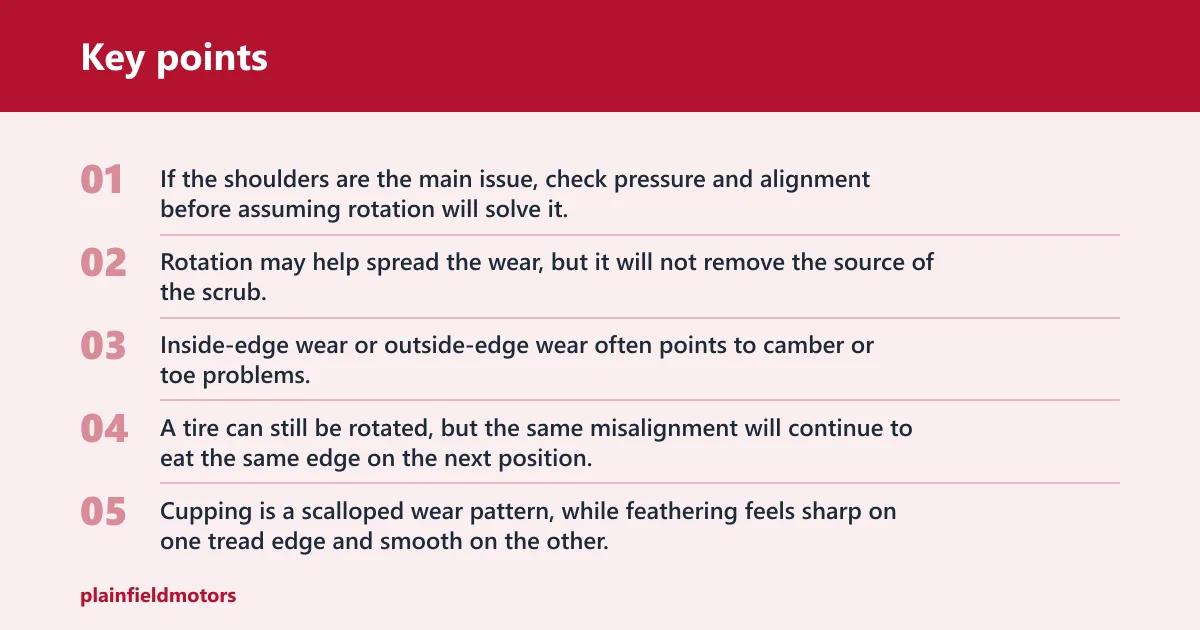
Wear on both outer shoulders often points to underinflation, while one shoulder worn more than the other can point to alignment. If the shoulders are the main issue, check pressure and alignment before assuming rotation will solve it. Rotation may help spread the wear, but it will not remove the source of the scrub.
Inside and outside edge wear
Inside-edge wear or outside-edge wear often points to camber or toe problems. A tire can still be rotated, but the same misalignment will continue to eat the same edge on the next position. That is why edge wear is a reason to inspect alignment first, then rotate only after the cause is addressed.
Cupping and feathering
Cupping is a scalloped wear pattern, while feathering feels sharp on one tread edge and smooth on the other. Those patterns often point to balance, alignment, or suspension wear rather than a simple rotation need. Rotation may be part of the fix, but it is not the fix by itself.
One tire wearing faster than the others
If one tire is clearly ahead in wear, compare it to the other tire on the same axle and the matching tire on the opposite axle. A single outlier can mean pressure loss, a damaged wheel, a suspension issue, or a tire defect. Rotation may slow the mismatch, but the cause still needs a look.
For example, the front-left tire may be at about 6/32, the front-right at about 7/32, and the rears at about 8/32. That spread suggests rotation is due, and a standard rotation can help even out the set if the tires are otherwise wearing normally.
Does your vehicle setup change the answer?
Yes. Vehicle layout and tire design change both the wear pattern and the rotation pattern. Front-wheel-drive, rear-wheel-drive, AWD, directional tires, and staggered setups do not all follow the same rule, and some cannot use a traditional cross rotation at all.
Front-wheel-drive vehicles
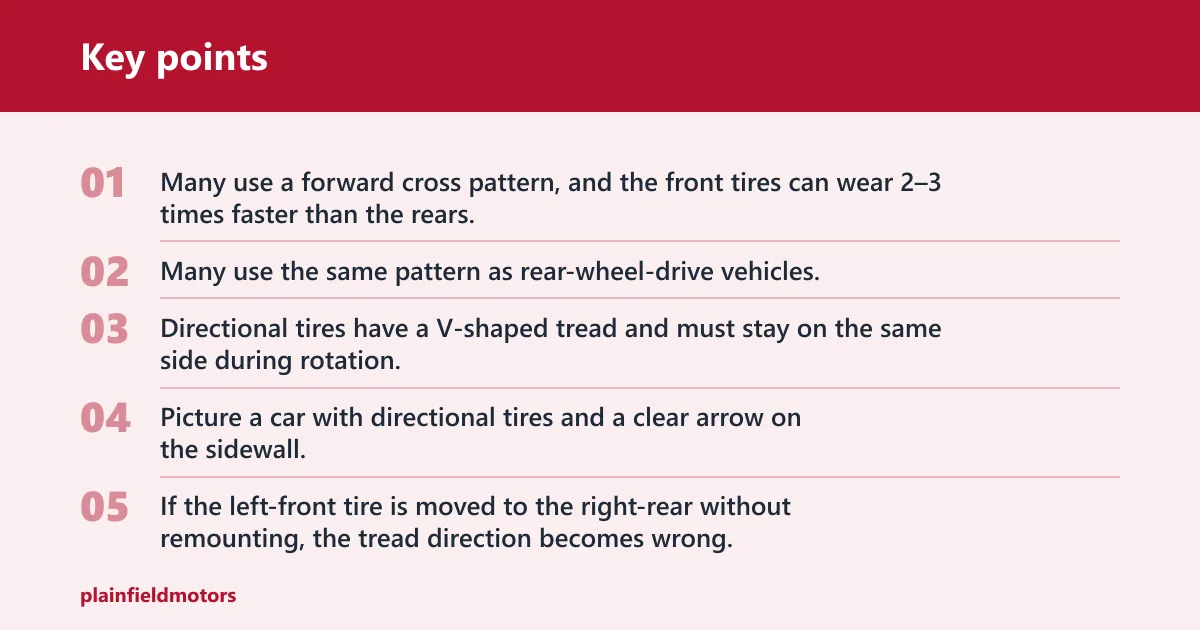
Front-wheel-drive vehicles often wear the front tires faster because the fronts handle steering, braking, and power delivery. Many use a forward cross pattern, and the front tires can wear 2–3 times faster than the rears. That makes regular rotation especially important if you want the set to wear together.
Rear-wheel-drive vehicles
Rear-wheel-drive vehicles can wear the rear tires faster under acceleration, especially when the car sees frequent throttle or carries load. Many use a rearward cross pattern. The key point is simple: the wear bias is different, so the rotation pattern must match the drivetrain rather than follow a one-size-fits-all rule.
All-wheel-drive vehicles
AWD, 4WD, and 4X4 vehicles still need regular rotation, and shorter intervals are commonly recommended because uneven tire diameter can affect the drivetrain. Many use the same pattern as rear-wheel-drive vehicles. That is one reason AWD owners should watch tread depth closely instead of waiting for obvious wear.
Directional tires and staggered setups
Directional tires have a V-shaped tread and must stay on the same side during rotation. They usually move front to back unless the tires are remounted. Staggered tire setups use different front and rear sizes, which limits standard rotation options and may allow only side-to-side movement or, in some cases, no traditional rotation at all.
Picture a car with directional tires and a clear arrow on the sidewall. If the left-front tire is moved to the right-rear without remounting, the tread direction becomes wrong. That is not a valid rotation; it is a fitment error.
Can rotation fix uneven wear?
Sometimes, yes. Rotation helps when wear is mostly a front-to-rear difference and the tires are still close enough in depth that moving them will make practical sense. It does not fix alignment, balance, inflation problems, or suspension wear, so the source of the wear pattern matters more than the symptom.
When rotation helps
Rotation helps when the set is due by mileage or time and the wear difference is modest. It also helps when the vehicle shows the expected axle-to-axle pattern, such as front wear on many front-wheel-drive cars or rear wear on many rear-drive vehicles. In those cases, rotation can slow the gap and extend the usable life of the set.
When alignment comes first
Wheel alignment is separate from rotation. If the tire shows toe wear, a pull, or edge scrub, alignment should be inspected before or with rotation. Rotating a tire with bad alignment only moves the wear to a different corner of the car.
When inflation or suspension needs attention
Tire pressure should be checked to spec during service, because underinflation can create edge wear. Suspension wear can also produce cupping, uneven contact, and a repeated pattern that rotation cannot fix. If the same abnormal wear keeps returning, the next step is inspection, not another rotation alone.
What to check before you book service
A fast home check can tell you whether you need rotation, alignment, balance, or a deeper inspection. Use a tread gauge if you have one, compare the four positions, and look for wear shape as well as wear depth. Then decide whether the problem is normal rotation timing or something more specific.
-
Measure all four tires.
Check tread depth at the inner, center, and outer grooves on each tire, then compare front to rear. A spread of about 2/32 inch or more across positions is a strong sign that rotation is due or that a different problem is building.
-
Check pressure to spec.
Read the door-jamb placard or owner’s manual and set all four tires to the listed pressure when the tires are cold. Underinflation can create shoulder wear, while overinflation can crowd wear toward the center.
-
Look for pattern clues.
Watch for feathering, cupping, or one edge wearing faster than the other. Those patterns point away from simple rotation and toward alignment, balance, or suspension inspection.
-
Check the setup type.
Confirm whether the tires are directional or staggered before asking for a standard rotation. If the setup limits movement, the shop may need a side-to-side pattern, a front-to-back pattern, or no traditional rotation at all.
Family Handyman lists uneven tire tread wear as a sign of overdue rotation, and vibration through the steering wheel or seat as another clue. Those signs are useful, but they should trigger a deeper check, not a guess. Balance, alignment, and inflation still need separate attention when the wear pattern points that way.
Frequently asked questions
How do you know if your tires need rotated?
Compare tread depth front to rear and look for uneven wear, especially if one axle is clearly more worn than the other. If the spread is about 2/32 inch or more, or if the vehicle is near its mileage interval, rotation is likely due. Check the manual first for any special schedule.
Can uneven tire wear mean I need a rotation?
Yes, if the wear difference is the normal front-to-rear kind and the tires are otherwise wearing evenly. Uneven wear can also mean alignment, inflation, or suspension trouble. Shoulder wear, edge wear, cupping, and feathering should be checked before assuming rotation alone will solve the problem.
Will vibration or noise mean my tires need rotating?
Not by itself. Vibration can point to balance issues, bent wheels, alignment problems, or suspension wear, and noise can come from several causes. Rotation may be part of the service, but it should not be treated as proof that rotation alone will fix the vehicle.
Can tire rotation fix uneven wear?
It can help when the wear is still moderate and the issue is mostly axle-to-axle wear difference. It cannot correct misalignment, underinflation, balance problems, or suspension wear that caused the pattern in the first place. If the wear is already severe, inspection comes before rotation.