Can You Get a Vehicle History Report by License Plate?

Yes, some services can use a license plate to pull a vehicle history report, but the result is only as reliable as the plate-to-VIN match and the state data behind it. Miss that match, and you can buy a car with hidden title brands, odometer problems, or open recalls. This guide explains what a plate lookup can show, where it falls short, and when you still need the VIN before you pay.
Can you get a vehicle history report by license plate?
Yes, in many cases you can start with a license plate and get a vehicle history report or a partial match that leads to one. A plate lookup often returns the VIN, year, make, model, and trim, but the result depends on state plate formats, DMV matching, and how complete the database is for that vehicle.
The key point is simple: a plate lookup can identify a vehicle, but it is not a guaranteed substitute for the VIN. If the plate has changed, the vehicle moved across states, or the database is thin, the report can be incomplete or mismatched. A VIN search is still the stronger identity check.
What a plate lookup can identify
A license plate lookup usually tries to connect the plate to a specific vehicle record. When it works well, you may get the VIN plus core identity fields such as year, make, model, and trim. That makes the plate useful as a first filter before you ask the seller for more documentation.
Some services also use the plate to surface a history report with accident clues, title brands, mileage events, theft signals, lien flags, and recalls. VinAudit offers both VIN and license plate entry on its homepage, and Platelookup.app says its search works by license plate or VIN.
Why the VIN is still the strongest match
The VIN is the best match because it is tied to the vehicle itself, while a plate can change with registration, moves, or plate transfers. A plate lookup may find the right car, but it may also point to a stale or partial record if the database normalized the plate differently than the state did.
Carfax advises asking the seller for the VIN if you do not have it. That is sensible because the VIN lets you confirm the exact car, then compare a broader set of records across title, insurance, auction, and mileage sources.
What can a license plate lookup tell you about a car?
A plate lookup can tell you more than basic identity. Depending on the provider and the data available, it may point to accidents, damage, title status, mileage history, theft or lien signals, and recall information. It can also reveal whether the vehicle has records that deserve a closer look before you meet the seller.
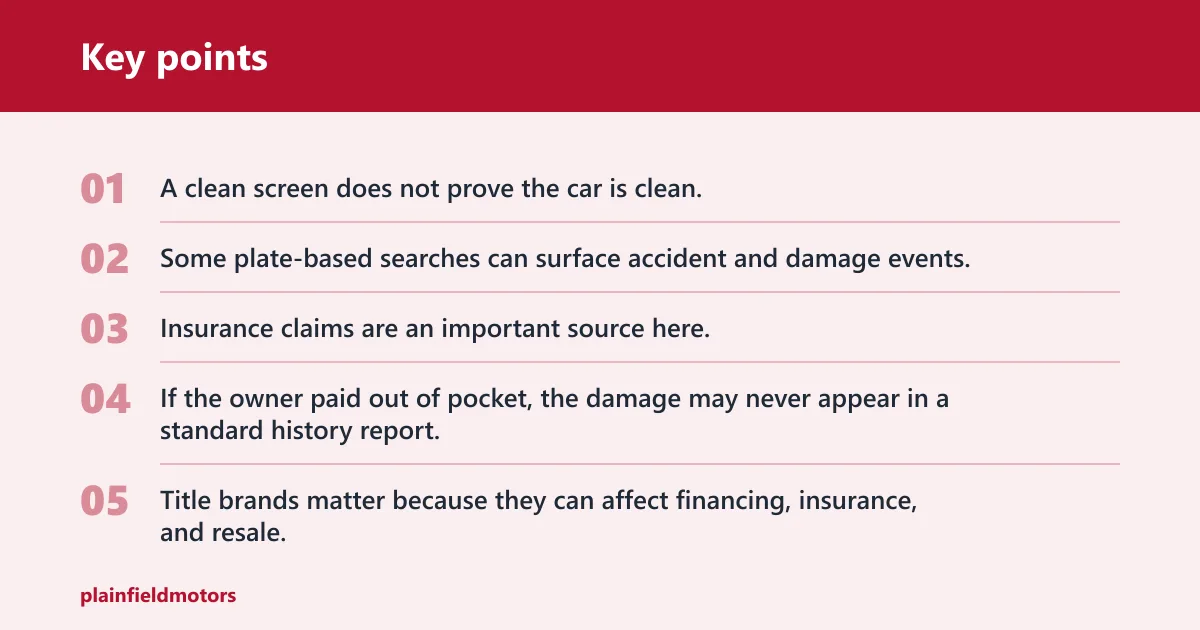
That said, each result depends on what was reported and where it was recorded. A clean screen does not prove the car is clean. It only means the sources queried did not flag a problem, or the problem never entered those records.
Accident and damage clues
Some plate-based searches can surface accident and damage events. FAXVIN says a plate lookup can reveal title, accident, odometer, and lien signals, and FAXVIN also cites 6.18 million police-reported crashes each year in the U.S. Those numbers matter because damage history can appear in one system and be absent from another.
Insurance claims are an important source here. They can reveal total-loss events and claim activity, but only if a claim was filed and reported. If the owner paid out of pocket, the damage may never appear in a standard history report.
Title brands and ownership history
Title brands matter because they can affect financing, insurance, and resale. Title brands may include clean, salvage, junk, rebuilt, flood, lemon, hail, and fire. Coverage varies by state and provider, so a vehicle can carry a branded title in one database and look ordinary in a weaker report.
VinAudit says its reports can include title issues, and Carfax says a report can uncover previous owners. VinAudit also says privacy laws prevent revealing previous owners’ names, which is why ownership data is usually limited to counts or transfer history rather than personal identities.
Mileage and recall checks
Odometer history is one of the most useful parts of a vehicle history report. It creates a mileage timeline from reported readings, and that timeline can expose rollback patterns or inconsistent readings when one event record does not fit the others.
The same source says its reports can include odometer readings and recalls, and Carfax lists mileage fraud among the risks a report can uncover. Recall data matters too, because an open recall can remain unresolved even when the car looks fine in person.
Plate lookup result -> what it means -> next step
| Plate lookup result | What it means | Next step |
|---|---|---|
| Exact match | The plate matched a specific vehicle record with consistent identity fields. | Compare the VIN on the dashboard and door jamb to the report before you continue. |
| Partial match | The database found a likely vehicle, but some fields are missing or inconsistent. | Ask the seller for the VIN and do not rely on the plate result alone. |
| No record | The lookup did not find usable data for that plate in the queried sources. | Treat the result as incomplete and request the VIN, title, and registration documents. |
| Mileage mismatch | Reported odometer readings do not follow a normal rising pattern. | Pause the purchase and verify service records, inspection slips, and the VIN-based report. |
| Salvage/title brand found | The vehicle has or had a branded title such as salvage, rebuilt, junk, flood, lemon, hail, or fire. | Ask why the brand was issued and confirm the repair history before you make an offer. |
| Lien/theft flag | The report suggests a lien, theft record, or related status issue. | Stop and verify the status with the seller, lender, or state record before paying anything. |
What sources power the report?
Plate-based reports usually combine several records, and each source helps with a different risk. NMVTIS and DMV records are central for title and registration matching, while insurance and auction records can add damage, loss, or sale history. A strong report pulls from more than one place because no single source sees everything.
That mix matters because records are uneven by state and by event type. A vehicle can have a clean DMV trail, an insurance claim, and a salvage sale record all at once. The report is only as good as the sources behind it.
NMVTIS and state DMV records
NMVTIS stands for the National Motor Vehicle Title Information System, an official U.S. Department of Justice database that tracks titles, odometer readings, theft, salvage, and junk records. That makes it one of the most important back-end sources for title-related checks.
DMV records are also a major source for plate-based matching. State title and registration data help connect a plate to a vehicle, but coverage varies by state. That is why a plate lookup can work well in one case and miss key details in another.
Insurance records
Insurance records can reveal claims and total-loss events, which is why they matter for accident history. They are useful when a collision led to a claim, an estimate, or a payout. They are less useful when the repair was handled privately or never reported to an insurer.
That gap is the reason a clean result should never be treated as proof of no damage. It may simply mean the damage never entered the insurance system.
Auction records
Auction records can add sale dates, sale prices, condition reports, damage photos, and bidding history where available. Copart, IAAI, and Manheim references are common in vehicle history data because they can reveal how a vehicle was presented for sale after damage or a loss event.
These records are especially helpful when you want to see whether the car passed through a salvage channel, how it was described, and whether the damage was visible in photos. They can also help explain why a title brand appeared later.
Do I need the VIN, or is the plate enough?
The plate is often enough to screen a car, but it is not always enough to buy a car with confidence. Use the plate to identify the vehicle, then ask for the VIN if the result is partial, missing, or contradictory. If the report already points to a brand, lien, or mileage issue, the VIN becomes the next required check.
A plate lookup is useful when you are trying to decide whether a car is worth a deeper look. It is less useful when you are ready to sign papers. At that point, you want the exact VIN, the title, and the registration details to line up.
When a plate is enough to screen a car
A plate can be enough for an early screen if the lookup returns an exact match with consistent year, make, model, trim, and no major red flags. It is also helpful when you are comparing several listings and need a fast way to remove obvious problems before a call or visit.
Say your search returns the correct vehicle, a stable mileage trail, and no title brand. That is a decent screening result. It is still not a final buy signal, but it can justify asking for the VIN and moving to the next step.
When to ask for the VIN before paying
Ask for the VIN before any deposit if the lookup is partial, the car has moved across states, or the report shows a mismatch. Also ask for it if the seller refuses to share it or if the vehicle has a branded title, lien signal, or mileage inconsistency.
Picture a 2019 sedan with a plate lookup that returns the right make and model but no trim and a lower odometer reading than the seller claims. That is a stop sign. The VIN can confirm whether the lookup matched the right car or a related record that belongs to another vehicle.
How to run a plate search before buying a used car
Start with the plate, then verify the result against the vehicle itself. The goal is to catch mismatches before you spend money. If the plate search points to the wrong car or incomplete data, slow down and request the VIN.
A basic search usually asks for the state, the plate number, and sometimes the plate type. Some services also let you switch to VIN entry if the plate result is not strong enough.
Select the state. Choose the issuing state first, because plate formats and record coverage vary by state. A plate entered into the wrong state can produce a false mismatch or no result at all.
Enter the full plate. Type the plate exactly as it appears, including letters and numbers with no extra spaces if the form is strict. A vanity plate, specialty plate, or old-format plate may need an exact entry to match correctly.
Review the match. Check the year, make, model, trim, and VIN if the service returns one. If any of those fields do not fit the car in front of you, stop and ask for the title or registration documents.
Open the full report. Look for accidents, title brands, odometer readings, theft or lien flags, and recalls. A free preview may be enough to decide whether the car deserves a paid report, but a paid report usually contains more detail.
Compare with physical proof. Match the report to the VIN plate on the dashboard, the door-jamb label, and the seller’s paperwork. This matters because plate data can lag behind the car, while the VIN on the vehicle is the best identity check.
When records are missing or incomplete
Missing data does not mean a clean car. It usually means the record was never reported, never merged into the database, or was lost in a transfer gap. A plate lookup can miss important damage or fraud when the car moved between states, changed plates, or used an unusual registration format.
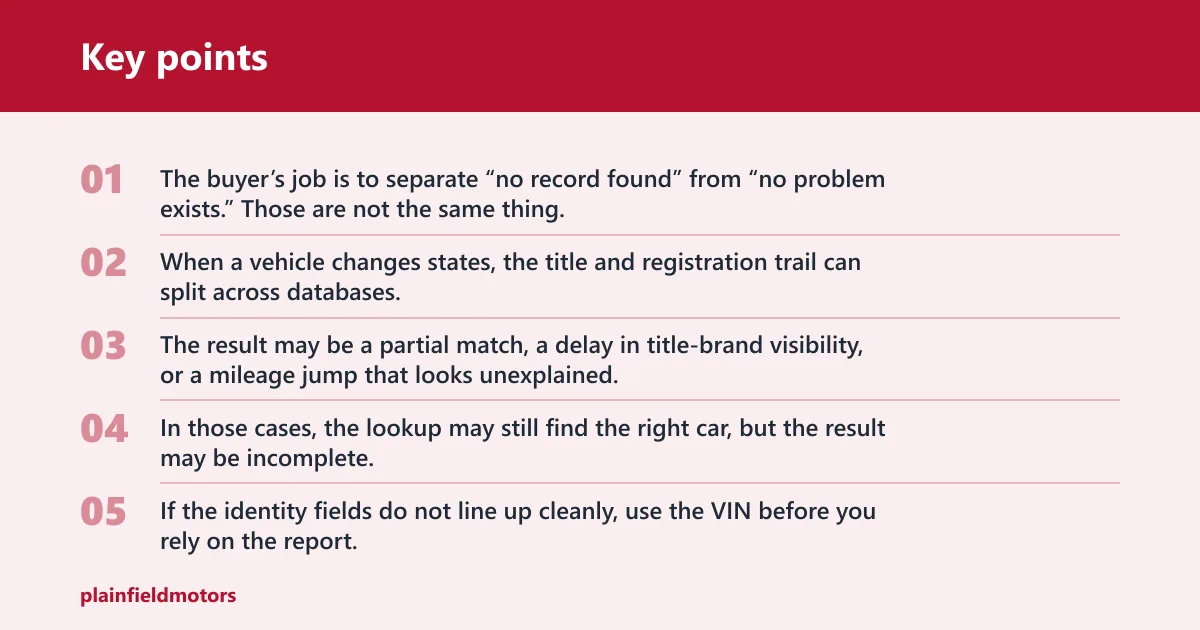
That is why a quiet report should be treated as incomplete, not reassuring by default. The buyer’s job is to separate “no record found” from “no problem exists.” Those are not the same thing.
Transfer gaps and out-of-state moves
When a vehicle changes states, the title and registration trail can split across databases. That can create a gap where one state has part of the history and another state has the rest. The result may be a partial match, a delay in title-brand visibility, or a mileage jump that looks unexplained.
A common first-timer mistake is to trust the first clean report without checking whether the car was recently imported from another state. That is exactly when a VIN-based follow-up matters most.
Vanity, specialty, or old plate formats
Vanity plates and specialty plates can complicate matching because the plate itself may not follow the standard pattern the database expects. Older plate formats can also create normalization issues if the state changed plate styles, spacing, or numbering conventions over time.
In those cases, the lookup may still find the right car, but the result may be incomplete. If the identity fields do not line up cleanly, use the VIN before you rely on the report.
Why missing data does not mean a clean car
A missing accident record does not prove the car has never been damaged. It may simply mean the event was not reported to insurance, never entered the title file, or was not captured by the provider’s source set. The same warning applies to mileage, theft, and lien data.
That is also why paid reports usually make more sense than a basic free lookup. The same source says its free basic report is limited, while paid reports may include damage and title brands. If the car matters enough to buy, the fuller report is usually the safer choice.
Frequently asked questions
What can a license plate lookup tell me about a car?
A plate lookup can sometimes reveal the VIN, year, make, model, trim, title status, accident clues, mileage readings, theft flags, lien signals, and recalls. It may also point to auction history and ownership counts. Exact coverage varies by provider and by what was reported.
Can a plate lookup show accidents, title issues, or mileage?
Yes, it can sometimes show those items, but not always. Insurance claims, title files, and odometer events are the main sources, and each one can be incomplete. A clean lookup does not mean no accident or no rollback; it may just mean no report was captured.
Is license plate lookup legal and private?
Plate lookup is generally used for vehicle data, not personal identity. Privacy laws limit what most reports reveal, which is why owner names are usually not shown. You should expect vehicle information, not a full profile of the current or previous owner.
What is the difference between a free and paid plate lookup?
A free lookup is usually limited to basic identification or a short preview. A paid report is more likely to include damage, title brands, mileage detail, and source history. If you are close to buying, the paid version is usually the more useful screening tool.