What Is the Recommended Vehicle Maintenance by Mileage?

Recommended vehicle maintenance by mileage is the factory schedule, with safety items first. If records are missing, a common starting point is oil every about 5,000–7,500 miles, filters every about 15,000–30,000 miles, brake fluid every about 2 years, and timing-belt checks at the listed interval. Skipping service can lead to breakdowns, longer stopping distances, and repairs that cost far more than routine work. This guide gives a mileage-and-time roadmap, separates safety items from condition-based items, and shows what to handle first when history is unknown.
How do mileage and time work together?
Mileage is only one trigger. Some services come due by distance, while others age out on the calendar even if the odometer stays low. That matters for brakes, fluids, rubber parts, and any car that spends years on short trips.
Mileage-based items
Oil and filter service, tire rotation, air filters, spark plugs, and timing-belt service usually fall into mileage bands, although the exact interval depends on the vehicle and the oil, parts, or engine layout. A common approach is to group them by wear rate, then check the owner’s manual for the exact schedule.
Time-based items
Brake fluid is the clearest example. It absorbs moisture, which lowers its boiling point and can cause corrosion, so many manufacturers recommend replacement every 2 to 3 years even when mileage is low. BMW brake fluid, for example, is recommended every 2 years.
Normal versus severe driving
Short trips, stop-and-go traffic, towing, cold starts, heat, and dust can all count as severe use. That shortens intervals for oil, transmission fluid, air filters, and sometimes spark plugs. If a car sees more than one of those conditions, use the shorter interval, not the average one.
Mileage service priority matrix
This table is a planning tool, not a substitute for the owner’s manual. Use it to decide what to inspect first, what can usually wait, and which items need time-based attention even if the car has not covered many miles.
| mileage band | time-based overrides | priority level | failure risk |
|---|---|---|---|
| 0–7,500 miles | Oil and filter can still be due by 1 year; brake fluid can still be due by time; severe use may shorten oil intervals. | Safety-critical: brake fluid inspection and any recall or leak check. Wear item: oil and filter if time has passed. Condition-based: tire rotation only if tread wear is uneven. | Low mileage does not remove age-related fluid risk. Old brake fluid, degraded oil, and stale air filters can still cause problems. |
| 7,500–15,000 miles | Oil and filter often fall in this band for some vehicles; tire rotation is commonly due at 5,000 to 7,500 miles. | Wear item: oil and filter, tire rotation, and basic tire inspection. Safety-critical: brake inspection if braking feels off or records are missing. | Moderate. Missed rotations can create uneven tire wear, and delayed oil service raises wear risk in severe use. |
| 15,000–30,000 miles | Engine air filter and cabin air filter often land here; some vehicles need more frequent service in dust. | Wear item: engine air filter, cabin air filter, tire rotation. Condition-based: fuel system and battery checks if drivability changes appear. | Moderate. Restricted airflow can hurt HVAC performance and engine breathing, while neglected rotations can shorten tire life. |
| 30,000–60,000 miles | Transmission fluid services may fall in this range; brake fluid may be due by age regardless of miles. | Safety-critical: brake fluid if age-based, brake inspection, and any fluid leak check. Wear item: transmission fluid service, filters, and belt inspection where applicable. | Moderate to high. Missed fluid service can accelerate wear and, in some drivetrains, lead to expensive repair work. |
| 60,000–100,000 miles | Spark plugs are often due in this range; timing belts are commonly specified around 60,000 to 105,000 miles on belt-equipped engines. | Safety-critical: timing-belt service on equipped engines. Wear item: spark plugs, transmission fluid, coolant, and belt-driven water pump if accessible. | High. A failed timing belt can cause serious engine damage, and worn plugs can cause rough idle and poor fuel economy. |
| 100,000+ miles | Age and wear matter as much as miles. Fluids, seals, hoses, plugs, mounts, and cooling parts need closer inspection. | Safety-critical: timing system status, brake fluid, brakes, tires, and any cooling-system leak. Wear item: plugs, filters, belts, and fluid refreshes. Condition-based: component replacement after inspection. | High. High-mileage vehicles need closer attention to fluids, deposits, and wear items, especially if records are incomplete. |
What is due at 30,000 miles?
At 30,000 miles, the common priorities are filters, tire rotation, and a close look at fluids and brakes. The exact list depends on the vehicle, but this is the checkpoint where maintenance often moves from basic wear items to condition-based service decisions.
Safety-critical checks
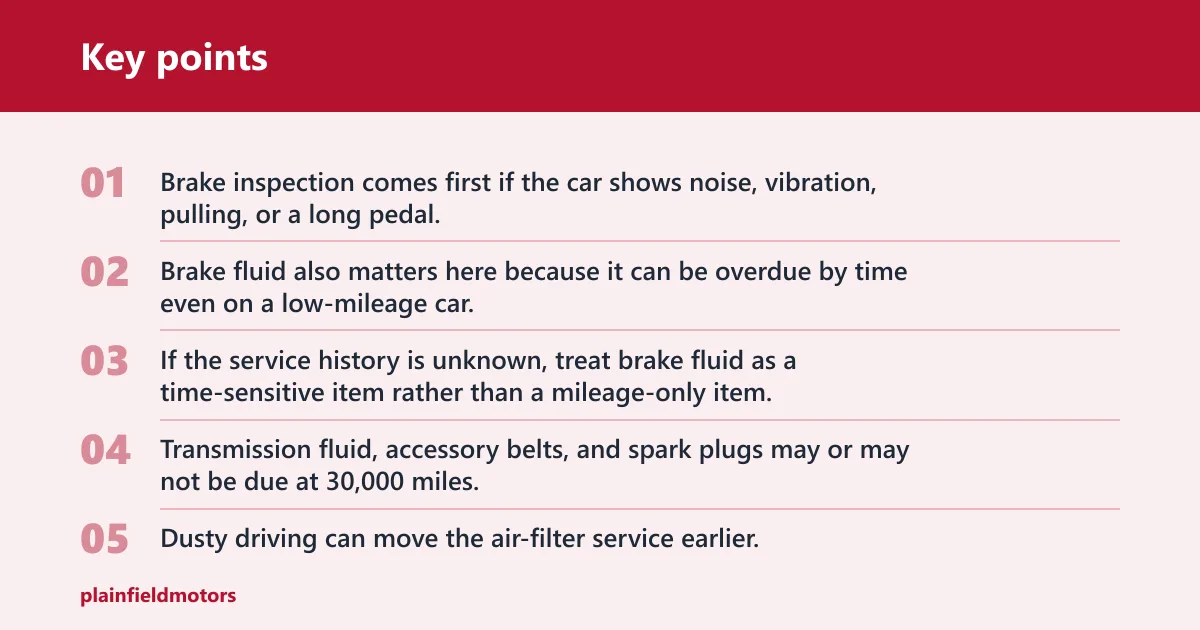
Brake inspection comes first if the car shows noise, vibration, pulling, or a long pedal. Brake fluid also matters here because it can be overdue by time even on a low-mileage car. If the service history is unknown, treat brake fluid as a time-sensitive item rather than a mileage-only item.
Wear items to inspect
The common 30,000-mile checkpoint includes engine air filter replacement, cabin air filter change, fuel system inspection, and tire rotation. BMW air filters are recommended for inspection or replacement every 15,000 to 30,000 miles, and cabin air filters are often replaced every 15,000 to 25,000 miles or yearly.
Condition-based services
Transmission fluid, accessory belts, and spark plugs may or may not be due at 30,000 miles. Those intervals vary widely by vehicle, so this is the point to check the manual instead of assuming a universal schedule. Dusty driving can move the air-filter service earlier.
What is due at 60,000 miles?
Sixty thousand miles is where many cars need a fuller service pass. Fluids, plugs, and timing-related checks start to matter more, and the exact list changes with engine design, transmission type, and whether the car has a timing belt.
Fluids and filters
At 60,000 miles, the guide often includes brake fluid flush, transmission fluid service, spark plug replacement, extensive brake check, and coolant exchange. Many manufacturers recommend brake fluid replacement every 2 to 3 years, so time can make this service due before the odometer does.
Plugs and belts
Spark plugs are often due between 60,000 and 100,000+ miles. BMW spark plugs are often due between 60,000 and 80,000 miles. Worn plugs can cause rough idle and poor fuel economy, so drivability complaints at this mileage deserve a plug check.
Repair planning
If the engine uses a timing belt, 60,000 miles may be the start of a serious service window. Timing belt replacement is commonly specified between about 60,000 and 105,000 miles. Water pump replacement is often paired with the belt when belt-driven because the labor overlaps, so combined service can make sense when access is shared.
What should you replace at 100,000 miles?
At 100,000 miles, focus on timing components, plugs, fluid condition, and anything that affects reliability under load. This is also where records matter most, because a car can look fine and still be overdue on a time-based service or a mileage-only wear item.
Timing belt and water pump
On belt-equipped engines, timing-belt service becomes the top priority if it has not already been done. Failure can cause serious engine damage. If the water pump is belt-driven and the service overlap is there, replacing it at the same time often avoids repeating the same labor later.
Spark plugs
Many vehicles reach the spark-plug interval by this point, and some reach it earlier. BMW spark plugs are often due between 60,000 and 80,000 miles, which shows why the manual matters more than a generic odometer target. If idle quality, fuel economy, or cold-start behavior changes, inspect plugs sooner.
High-mileage fluid checks
High-mileage vehicle care usually means closer attention to oil consumption, coolant level, transmission-fluid condition, brake fluid age, and small leaks. Sea Foam defines high mileage vehicles as those over 75,000 miles. At this stage, a tired hose or seal can become a bigger problem than the next scheduled filter change.
Say your car has 92,000 miles, no records, and a timing belt engine. The first move is not a cosmetic service. It is to verify timing-belt status, then check brake fluid age, plug interval, and tire condition before scheduling less urgent items.
How do you spot severe-schedule driving?
Severe-schedule driving is not rare. If your car does repeated short trips, idles in traffic, tows, lives in dust, or faces very cold or very hot weather, the maintenance clock moves faster. Mixed-use drivers should assume the shorter interval when more than one severe condition applies.
Short trips and stop-and-go traffic
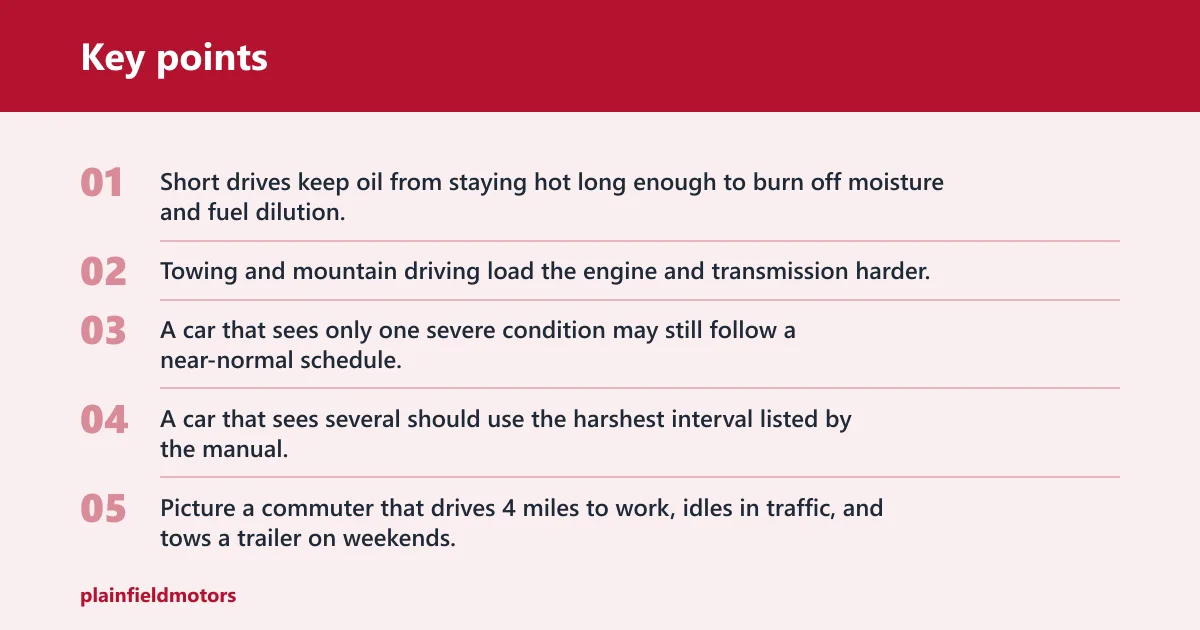
Short drives keep oil from staying hot long enough to burn off moisture and fuel dilution. Stop-and-go traffic adds heat and wear without many miles, which is why a car can need service well before a mileage target. That is also why annual oil service still matters for low-mileage drivers; BMW recommends annual oil changes if the car is driven fewer than 7,500 miles per year.
Towing, heat, cold, and dust
Towing and mountain driving load the engine and transmission harder. Dust clogs engine and cabin filters faster. Cold weather increases short-trip severity because warm-up time gets longer, while heat raises the strain on fluids and cooling components.
How severe use changes intervals
Severe use shortens oil, transmission-fluid, and filter intervals, and it can move spark-plug or brake-fluid service forward too. A car that sees only one severe condition may still follow a near-normal schedule. A car that sees several should use the harshest interval listed by the manual.
Picture a commuter that drives 4 miles to work, idles in traffic, and tows a trailer on weekends. The odometer may stay modest, but that mix counts as severe use. Oil and transmission service should be checked against the shorter schedule, not the calendar that fits highway-only driving.
Used car maintenance when records are missing
When records are missing, start with items that affect safety, then move to wear items, then handle condition-based services after inspection. The goal is to reset uncertainty, not replace everything at once.
Check oil and filter first. Change the oil if the interval is unknown, the oil looks contaminated, or the car is past the time limit in the manual. BMW oil and filter service is recommended every 7,500 to 10,000 miles, or once a year, whichever comes first.
Inspect brake fluid next. Brake fluid can be overdue by age even if the car has low mileage. Many manufacturers recommend replacement every 2 to 3 years, and BMW brake fluid should be replaced every 2 years.
Check tires and rotation history. Confirm tread depth, uneven wear, tire age, and whether the tires were rotated on schedule. Typical tire rotation interval is every 5,000 to 7,500 miles, and neglected rotation can hide alignment or suspension issues.
Replace filter wear items. Inspect or replace the engine air filter and cabin air filter if their age is unknown.
Verify timing and plugs. If the engine has a timing belt, confirm whether it has been replaced on time.
Frequently asked questions
How many miles for car maintenance?
There is no single mileage that covers every service. Oil and filter changes may be due around 5,000 to 10,000 miles, tire rotation around 5,000 to 7,500, filters around 15,000 to 30,000, and spark plugs much later. Time-based items can still be overdue at low miles.
Car maintenance by mileage or time
Use both. Mileage helps with wear items, while time matters for fluids and parts that age even when the car sits. Brake fluid is the clearest example, because moisture absorption lowers its boiling point and can cause corrosion long before the odometer reaches a big number.
What maintenance is due at 30,000 miles?
Common 30,000-mile services include engine air filter replacement, cabin air filter change, tire rotation, and a fuel system inspection. Brake checks should be done sooner if symptoms are present, and brake fluid may be due by time even if the car has not reached a mileage target.
What maintenance is due at 60,000 miles on a car?
At 60,000 miles, many cars need brake fluid service, transmission fluid service, spark plug replacement, a brake inspection, and sometimes coolant exchange. If the engine uses a timing belt, this is also a key point to confirm its interval and any water pump overlap.
How do I know if my car needs severe-schedule maintenance?
If your driving includes short trips, stop-and-go traffic, towing, dust, cold starts, or hot-weather use, use the severe schedule. If more than one of those conditions applies, choose the shorter interval in the manual. Severe use shortens oil, transmission-fluid, and filter intervals first.
What maintenance should you do first on a used car?
Start with oil and filter, brake fluid, tire condition, and the engine and cabin air filters. Then verify spark plug and timing-belt status if the mileage or age points to either one. Missing records make safety-related items the first priority, not the cosmetic ones.
How to maintain a car with high mileage
High-mileage care means watching fluids, seals, plugs, tires, and cooling parts more closely. Over 75,000 miles is often treated as high mileage, so inspect for leaks, rough idle, low fluid levels, and uneven wear. Do not wait for a failure if the interval is already overdue.