What Counts as High Mileage for a Used Car?

A used car is usually high mileage when it averages much more than 12,000 miles a year, or lands around 100,000 miles on an older car; lower readings can still be risky if wear is heavy. Ignore that rule, and you can overpay for a car with expensive repairs ahead. This guide shows how age, condition, use pattern, and service history change the answer.
Mileage benchmarks by age
The quickest rule is mileage per year. A common rule of thumb is roughly 12,000 miles a year, so compare the odometer to the car’s age instead of using one hard cutoff. Mileage is one of the first things a buyer checks, but age, records, and use pattern often matter just as much.
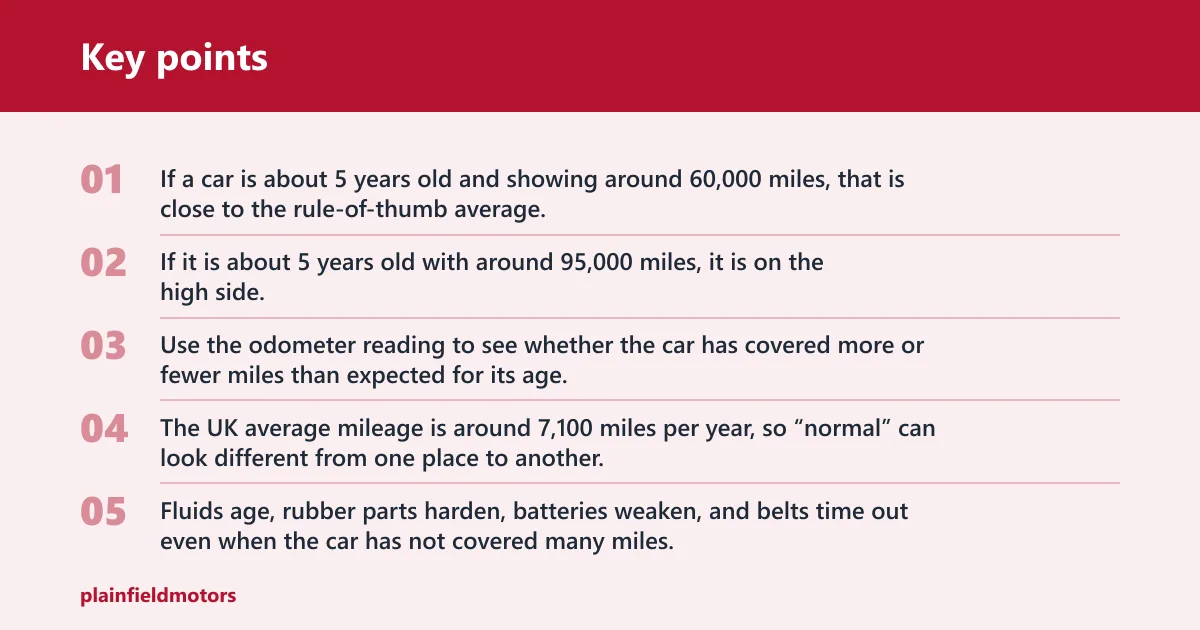
If a car is about 5 years old and showing around 60,000 miles, that is close to the rule-of-thumb average. If it is about 5 years old with around 95,000 miles, it is on the high side. If it is 10 years old with 100,000 miles, many buyers will call it high mileage in the UK benchmark, but that does not make it a bad buy on its own.
The 12,000 miles-per-year rule
Use the odometer reading to see whether the car has covered more or fewer miles than expected for its age. That rule shifts by market and vehicle type. The UK average mileage is around 7,100 miles per year, so “normal” can look different from one place to another.
Why age matters as much as mileage
Age brings its own wear. Fluids age, rubber parts harden, batteries weaken, and belts time out even when the car has not covered many miles. A low-mileage 12-year-old car can still need more work than a 4-year-old car with a bigger number on the clock.
Why 100,000 miles is a milestone, not a finish line
Many buyers treat 100,000 miles as a mental milestone. That is useful as a filter, but it is not a failure point. A modern turbo-petrol engine can run past 150,000 miles with servicing, while a neglected car can need major work much earlier.
Is a high-mileage used car still worth buying?
Yes, if the price and records match the risk. High mileage can be fine when the car has complete service history, clear maintenance records, and no signs of major wear. It becomes a pricing issue when the odometer is high but the seller still asks for low-mileage money.
It should push you away when the mileage comes with warning signs that point to expensive powertrain work, neglected fluids, or a car that has been used hard without proof of maintenance. The effect of mileage is bigger on newer, pricier cars, so the same odometer reading can matter more on one car than another.
When mileage is acceptable if the records are complete
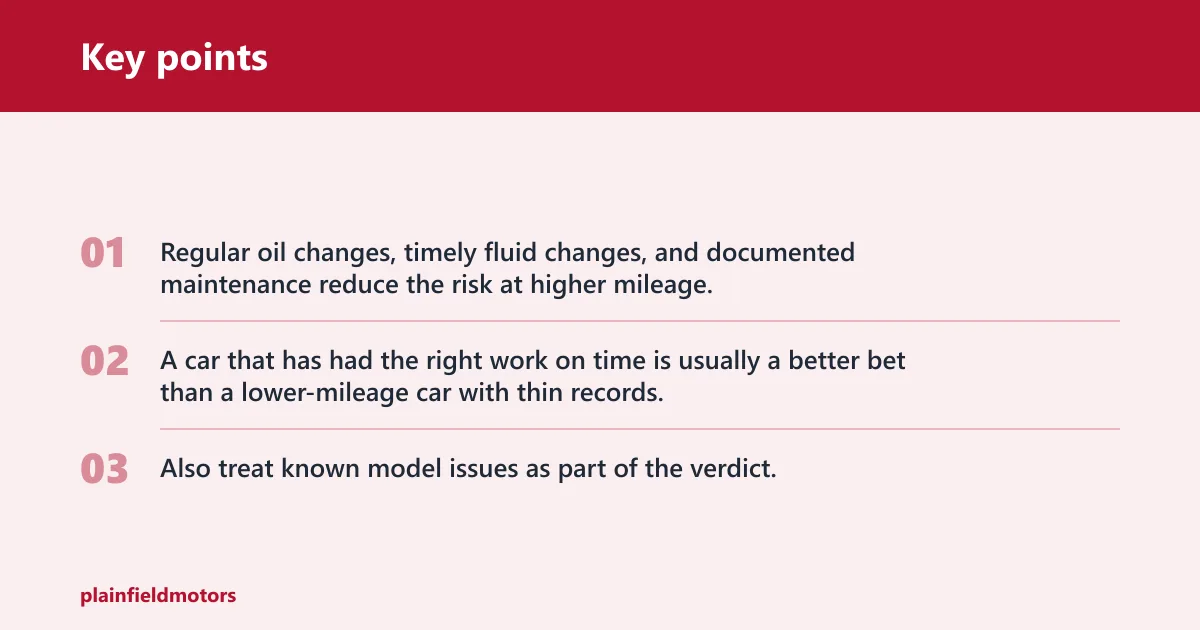
Regular oil changes, timely fluid changes, and documented maintenance reduce the risk at higher mileage. A car that has had the right work on time is usually a better bet than a lower-mileage car with thin records. For many buyers, that service trail is what turns “high mileage” into “worth a look.”
When mileage is a pricing problem, not a deal-breaker
A three-year-old car with 60,000 miles can still be a smart buy if the price reflects the use. That is especially true when the car is otherwise tidy and the service file is strong. The mileage is not the issue by itself. The ask price is.
When the odometer should push you away
Walk away if the car has high mileage, patchy records, and symptoms of wear in the engine, transmission, suspension, or brakes. Also treat known model issues as part of the verdict. A car with a reputation for weak timing gear, brittle suspension parts, or expensive gearbox faults needs a wider safety margin.
How age changes the mileage answer
Age changes what the odometer means. Cars on the road for many years face time-based wear even if they have not covered many miles, while a younger car can wear faster if it has seen hard use. The better question is not “how many miles?” but “how many miles, over how many years, with what kind of use?”
Low-mileage older cars and time-based wear
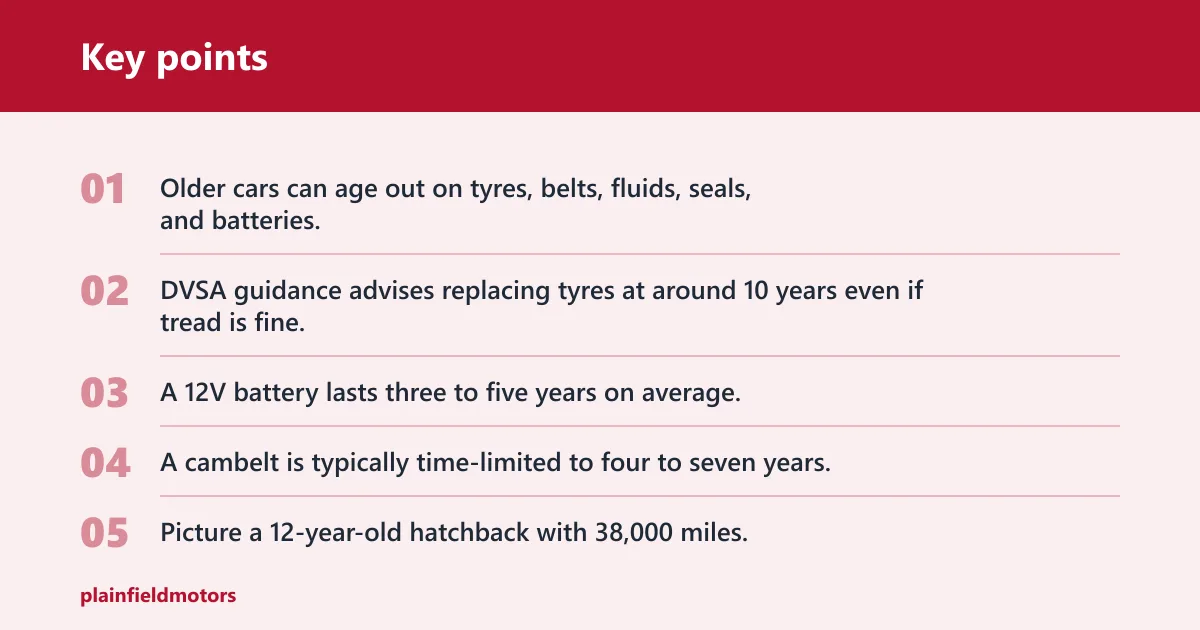
Older cars can age out on tyres, belts, fluids, seals, and batteries. DVSA guidance advises replacing tyres at around 10 years even if tread is fine. A 12V battery lasts three to five years on average. A cambelt is typically time-limited to four to seven years.
Picture a 12-year-old hatchback with 38,000 miles. That looks gentle on the clock, but age-related repairs can still be due. If the seller cannot show recent fluids, battery replacement, or belt work where applicable, the low mileage does not make it low risk.
Average-mileage cars by age band
The table below turns the rule into a buyer decision tool. It uses age bands, then shows what tends to count as normal, what can still be acceptable with proof, and when the asking price needs to do more of the work.
| Age band | Normal | High but acceptable if documented | Walk away unless priced accordingly |
|---|---|---|---|
| 0 to 3 years | Up to about 10,377 miles a year, or a car that sits close to the annual average for its market | About 12,000 to 15,000 miles a year with full dealer or specialist records | Much more than 15,000 miles a year, or any sign of missed servicing on a newer, pricier car |
| 4 to 6 years | Roughly 8,000 to 12,000 miles a year with even wear and tidy history | About 12,000 to 15,000 miles a year if brakes, tyres, fluids, and transmission service are current | Annual use above 15,000 miles, especially if the car shows tyre wear, fluid neglect, or gearbox shudder |
| 7 to 9 years | Close to 12,000 miles a year can still be normal if the car has been maintained well | 120,000 miles or more can be fine when the records are complete and wear items have been renewed | Big mileage gaps, missing service stamps, or visible suspension and brake wear without proof of recent work |
| 10 to 12 years | Around 100,000 miles is still acceptable on a cared-for car | Over 100,000 miles with clear timing, fluid, and brake history can be reasonable | High miles plus age-related wear on tyres, battery, belts, seals, or known weak points |
| Over 12 years | Lower annual mileage can be normal if the car has been kept in service properly | High mileage can work if the model is known for longevity and major services are documented | Any mix of high mileage, poor records, and model-specific fault history should be priced very low |
Very high annual mileage and what it can signal
A car over 10,000 miles a year is on the high side for a general car. RAC analysis says ex-fleet diesels can top 12,500 miles a year, so high annual mileage is not rare in every segment. The question is whether that use fits the vehicle type and service record.
What mileage says about condition and maintenance
Mileage is a filter, not a verdict. To judge condition, check service history, the driving pattern, wear items, and the powertrain. A high-mileage car with careful maintenance can be safer to buy than a lower-mileage car that has been ignored.
Service history that reduces risk
Look for regular oil changes, fluid changes, and maintenance records that match the car’s age and use. Missing gaps matter more on higher-mileage cars because wear compounds. If the book is thin, ask for invoices that show date, mileage, and the work done.
Check the service file. Look for oil changes, brake fluid, coolant, gearbox service where required, and evidence that scheduled work was done on time. A stamped book is useful, but invoices are better because they show mileage and dates.
Match records to mileage. Compare each service interval with the car’s yearly use. Long gaps or missing years can signal skipped maintenance, even if the odometer still looks acceptable.
Test the wear items. Inspect tyres, brakes, suspension, clutch, battery, and fluid condition during the viewing. Uneven tyre wear, clunks over bumps, or a vague clutch point can point to hard use or overdue repairs.
A common first-timer mistake is to see a clean interior and assume the car is mechanically fresh. A tidy cabin does not rule out worn suspension bushes, old tyres, or a gearbox that feels rough under load.
Driving pattern: motorway, city, and short trips
Motorway miles are usually easier on a car than city stop-start use. Constant short trips can leave an engine under-heated, which is harder on oil, exhaust parts, and batteries. City use also tends to wear brakes, clutch parts, and transmission components faster per mile.
Suppose two cars both show 80,000 miles. One spent most of its life on long motorway runs. The other did repeated short school-run trips. The odometer is the same, but the wear pattern is not. That difference can change the price you should pay.
Wear items and powertrain checks
Check the parts that absorb age and mileage first. Brakes, suspension, clutch, tyres, battery, and fluids are the usual wear items. Then listen and feel for engine and transmission wear, because those are the repairs that can turn a “reasonable” car into an expensive one.
Powertrain condition matters because it decides repair risk. A noisy engine, slipping gearbox, delayed shifts, or smoke under acceleration can mean larger bills ahead. Model reliability also matters here. Some cars stay strong well past 100,000 miles; others have known failure mileage and recurring weak points.
What matters more than the odometer on petrol, diesel, and EVs?
Petrol, diesel, and electric cars do not age the same way, so mileage logic changes with the powertrain. Petrol and diesel buyers should compare miles to age and service history. EV buyers should put battery health ahead of the odometer, because battery state matters more than distance alone.
Petrol and diesel mileage expectations
For petrol cars, mileage averages are often judged against the 12,000-mile rule and the model’s known upkeep pattern. Diesel cars can handle heavier annual use, especially in fleet or long-distance duty. RAC analysis says ex-fleet diesels can top 12,500 miles a year, which helps explain why some diesel cars look “high” on paper but are still normal for their use.
Why diesel can age differently
Diesel cars often see more motorway use, which can suit them well. But they can also bring extra maintenance items, and short-trip use can be a problem. If the car has been used for brief runs, check for signs of blocked exhaust systems, soot-related faults, and incomplete service work.
Why EV buyers should focus on battery health
On an EV, the odometer is only part of the picture. Battery health, charging history, and thermal management matter more than a simple mileage cut-off. A lower-mileage EV with poor battery condition can be a worse buy than a higher-mileage EV with a healthy battery and clean records.
Frequently asked questions
What is considered high mileage for a used car?
High mileage is usually any reading that is well above 12,000 miles a year for the car’s age, or around 100,000 miles on an older vehicle. That is a guide, not a ban. Service history, driving pattern, and model reliability still decide whether it is a sensible buy.
What is considered high mileage for a used car in km?
A quick conversion puts 100,000 miles at roughly 160,000 km. That can be a common buyer milestone, but the same rule applies: compare distance to age and records. A well-kept car can be fine above that mark if the wear items and powertrain check out.
What is considered good mileage for a used car?
Good mileage is mileage that fits the car’s age and use. Around the 12,000 miles-per-year rule is a normal reference point, though the UK average is around 7,100 miles per year. A good car is one with realistic mileage, complete records, and no signs of hidden wear.
Is 100,000 miles high mileage for a used car?
Yes, for many buyers it is a high-mileage milestone, but it is not an automatic no-buy point. A 10-year-old car over 100,000 miles is considered high mileage in the UK benchmark, yet a well-maintained car at that reading can still be worth buying at the right price.
Does age matter more than mileage on a used car?
Age and mileage work together. Mileage shows use, while age brings time-based wear to tyres, belts, fluids, batteries, and seals. A low-mileage older car can still need work, so the smarter approach is to weigh both rather than choosing one over the other.