

Maintenance by Mileage: What to Service and When

Start with your owner’s manual, then use a mileage guide: oil changes are commonly recommended about every 5,000–10,000 miles, tire rotation about every 5,000–8,000 miles, engine and cabin air filters about every 15,000–30,000 miles, spark plugs about every 60,000–100,000 miles, and fluids at the maker’s interval or sooner under severe use. If you let those intervals slide, oil thickens with contamination, tire wear can turn uneven, filters restrict airflow, and neglected fluids can push heat, corrosion, and hard-part wear into expensive territory. This guide maps what to service now, what to inspect next, and what shifts to time- or condition-based care when records are missing.
The key rule is simple: when mileage and time disagree, the earlier interval usually wins. That matters most for low-mileage vehicles, because oil still ages, brake fluid absorbs moisture, coolant and belts age out, and tires can age even when tread looks usable. Severe use also moves several items forward: short trips, repeated stop-and-go driving, towing, dusty roads, extreme heat or cold, and long idle time all shorten service intervals.
Use mileage, time, or condition?
Use the first limit you hit: mileage for wear items, time for aging fluids and rubber parts, and condition checks once the vehicle gets older or passes 100,000 miles. Low annual mileage does not stop fluid aging, and severe use can move oil, tires, filters, and cooling-system checks earlier than the odometer suggests.
When the earlier interval applies
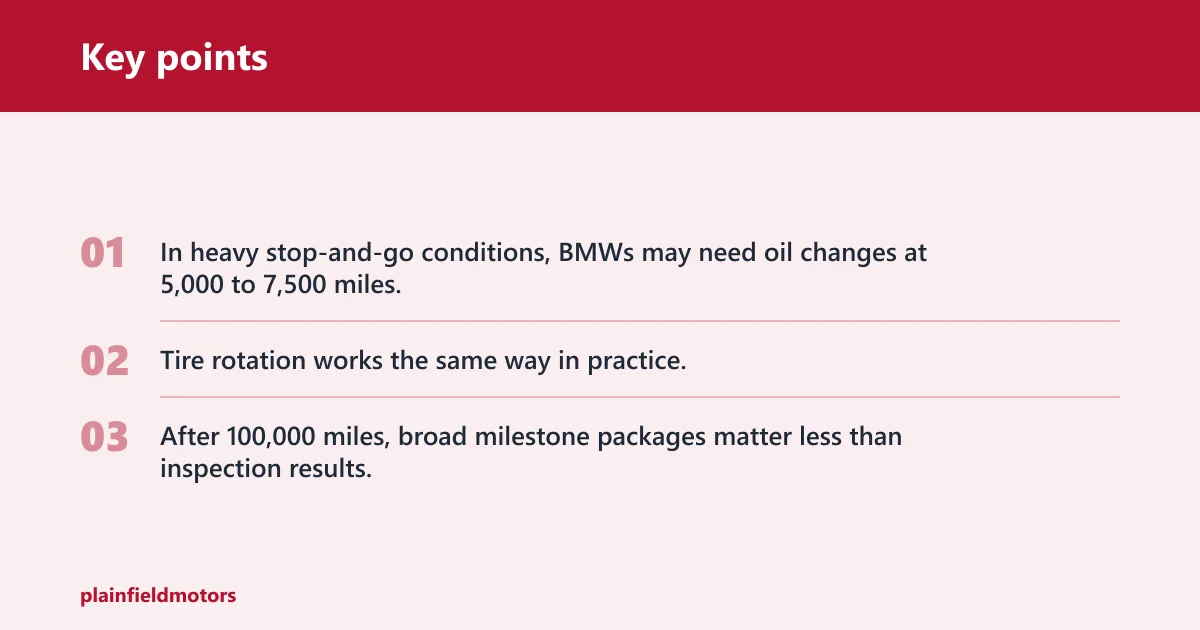
Engine oil is the clearest example. BMW oil and filter changes are recommended every 7,500 to 10,000 miles, or once a year, and low-mileage drivers still need annual oil changes. In heavy stop-and-go conditions, BMWs may need oil changes at 5,000 to 7,500 miles.
Tire rotation works the same way in practice. A common interval is every 5,000 to 7,000 miles, and it should happen sooner if you see uneven shoulder wear, feathering, vibration, or a pull that points to alignment trouble.
Services that are mostly age-based
Brake fluid is strongly time-based. It should be replaced every 2 years regardless of mileage because it absorbs moisture over time, which lowers boiling resistance and raises the risk of internal corrosion in calipers, lines, and the ABS hydraulic unit.
Coolant and belts also age. Coolant and belts are often described as aging out in 3 to 5 years, even when mileage is low, because corrosion inhibitors weaken and rubber hardens, cracks, or glazes.
Tire age matters too. High-mileage guidance notes that tires may need replacement around 6–10 years from manufacture even if tread remains, so the sidewall date code matters as much as tread depth once a vehicle gets older.
What changes after 100,000 miles
After 100,000 miles, broad milestone packages matter less than inspection results. Factory intervals still apply to any item with a clear replacement schedule, but suspension wear, hose condition, belt noise, seepage, tire wear patterns, and shift quality become the deciding factors for what moves to the front of the list.
Say your car has 112,000 miles, but records show spark plugs were done recently and the transmission service was done at the prior major interval. In that case, suspension wear, belt condition, tire age, brake fluid age, and cooling-system hose condition may deserve attention before repeating items that are not yet due.
Turn the manual into a mileage plan
A mileage-based checklist turns your owner’s manual into a simple service schedule you can act on now. The supporting guide walks through how to gather the mileage items your car needs, then sort them into overdue, due soon, and monitor so you are not guessing which service comes next.
That matters because mileage-based maintenance helps you catch fluid changes, wear parts, and interval services before they become expensive problems. Use the mileage checklist guide to build a priority list that fits your current odometer reading and keeps routine maintenance organized.
Mileage priority table
| Mileage band | Due now | Inspect soon | Usually age-based | Severe-use note |
|---|---|---|---|---|
| 0–15,000 miles | Engine oil and oil filter by the maker’s interval; tire rotation and tire inspection | Brake pad wear, tread depth, uneven wear, alignment pull, cabin air filter if airflow drops | Annual oil change for low-mileage driving; brake fluid by age if the car reaches the time limit first | Short trips, stop-and-go, towing, dust, heat, cold, and long idle time can shorten oil service toward 5,000 to 7,500 miles |
| 15,000–30,000 miles | Tire rotation; engine air filter inspection or replacement; cabin air filter on many vehicles | Brakes, alignment, battery condition, tire wear pattern, underbody leaks | Brake fluid if 2 years old; coolant and belts by age on low-mileage vehicles | Dusty roads and urban driving move air-filter service earlier; repeated idling and short trips can also shorten oil intervals |
| 30,000–60,000 miles | Oil service; tire rotation; engine air filter if not yet done; cabin air filter on many schedules | Brake wear, wheel alignment, coolant condition, transmission behavior, tire age, hose condition | Brake fluid every 2 years; coolant and belts if aging out before the mileage interval | Towing, heat, mountain driving, and stop-and-go use can bring transmission and cooling-system service closer |
| 60,000–100,000 miles | Transmission fluid service on many vehicles; brake fluid if due by time; coolant on many schedules; spark plugs on some engines | Timing belt status where applicable, water pump leakage, serpentine belt wear, suspension wear, cooling-system hoses | Brake fluid by age; belts and coolant if the vehicle reaches the time limit before the mileage mark | Heat, towing, heavy loads, and long idle time raise stress on transmission fluid, coolant, and belts |
| 100,000+ miles | Any overdue scheduled service; timing belt if applicable and due; condition-based fluid service; tire replacement if aged out | Suspension system, struts, shocks, serpentine belt, hoses, cooling-system pressure, leaks, steering play | Brake fluid, coolant age, belt age, tire date code | After 100,000 miles, severe use often means compressing inspection intervals and prioritizing cooling, suspension, and fluid condition over package labels |
What maintenance should be done at 30,000 miles?
At 30,000 miles, the usual due-now list is oil service, tire rotation, and a check of filters, with engine air filter replacement commonly landing here. Brake fluid depends more on age than mileage, while alignment, brakes, and transmission condition should be inspected and verified rather than replaced on a fixed package label alone.
Likely due now
The 30,000-mile checkpoint in the Motorized Focus guide includes engine air filter replacement. That fits the broader BMW guidance that engine air filters may need inspection or replacement every 15,000 to 30,000 miles.
Cabin air filter service also often lands in this range. When it loads up with dust and debris, HVAC airflow drops and in-cabin air quality suffers even if the engine runs normally.
Oil and tire rotation may be due as well, depending on where the last service was done. If the car last had oil at 22,000 miles, 30,000 is close enough to review the maker’s interval right away rather than waiting for the next round number.
Items to inspect and verify
At this mileage, inspect brake pad thickness, rotor condition, tread depth, and tire wear pattern. Uneven inside-edge wear points to alignment or suspension issues, not a tire-rotation problem alone.
Transmission fluid is usually a review item here, not an automatic replacement. Some vehicles list earlier service under severe use, while others wait until the next major interval. The owner’s manual and any service record label matter more than a generic package name.
What severe use can move earlier
Short-trip city driving can shorten oil intervals. Dusty roads can move both engine and cabin air filters earlier. Towing and hot-weather stop-and-go driving can move transmission and cooling-system attention forward even before the standard mileage checkpoint.
Suppose a crossover spends most weekdays in school-line traffic and weekend runs on dusty gravel roads. Even at 24,000 miles, the air filters may be dirty enough to affect throttle response, fuel economy, HVAC airflow, and windshield defog performance.
What maintenance is due at 60,000 miles?
At 60,000 miles, many cars reach a true decision point: transmission fluid service is common, coolant often comes into review, brake fluid may be due by age, and spark plugs may be near their replacement window. Timing belt review also matters here on engines that use a belt rather than a chain.
Fluids commonly due around this point
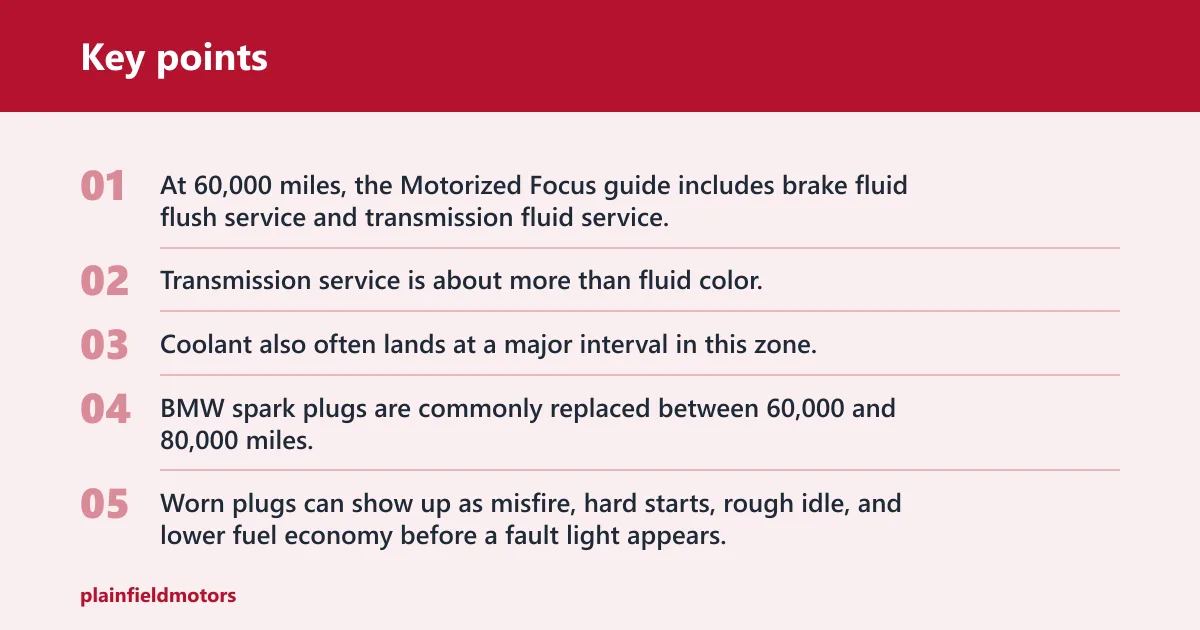
At 60,000 miles, the Motorized Focus guide includes brake fluid flush service and transmission fluid service. For transmission fluid, the right job depends on the vehicle: some call for a drain-and-fill, some specify a flush procedure, and some set a different interval entirely.
Transmission service is about more than fluid color. Fresh fluid helps maintain shift quality, clutch engagement, and heat control, especially on vehicles that tow, idle heavily, or spend their lives in traffic.
Coolant also often lands at a major interval in this zone. Its job is not only overheat protection; it also supports freeze protection and corrosion control inside the radiator, heater core, water pump, and engine passages.
Ignition and air-filter items to review
BMW spark plugs are commonly replaced between 60,000 and 80,000 miles. Worn plugs can show up as misfire, hard starts, rough idle, and lower fuel economy before a fault light appears.
Engine and cabin air filters may also need review if they were skipped earlier or the car sees dust and stop-and-go use. A clogged engine air filter can hurt performance and fuel economy. A clogged cabin filter cuts HVAC airflow and can make defrosting slower.
Timing belt and water pump decisions
Timing belts do not apply to every engine, but they matter a lot where fitted. A common replacement range is 60,000 to 100,000 miles, and failure on an interference engine can cause engine damage.
The Motorized Focus guide recommends timing belt replacement at 100,000 miles, but some engines land earlier in that broad window. The water pump is often replaced at the same time because labor overlaps; both parts usually sit in the same access area, so doing them together reduces repeat labor later.
How often should oil, filters, and spark plugs be changed by mileage?
Oil changes are usually the most frequent service, filters sit in the middle, and spark plugs are a longer-interval item.
Engine oil and oil filter
BMW oil and filter changes are recommended every 7,500 to 10,000 miles, or once a year. For heavy stop-and-go use, BMWs may need oil changes at 5,000 to 7,500 miles.
If the vehicle covers very few miles, the annual fallback still applies. Oil ages from heat cycles, condensation, and contamination even when the odometer hardly moves.
Engine air filter and cabin air filter
BMW air filters may need inspection or replacement every 15,000 to 30,000 miles. A dirty engine air filter can reduce airflow enough to affect acceleration feel and fuel economy, especially under load.
Cabin air filters commonly follow a similar 15,000 to 30,000 mile service pattern, though manuals vary. This filter matters for HVAC airflow and cabin air quality, not engine wear. If the blower sounds normal but air volume at the vents drops, the cabin filter moves up the list.
Spark plugs
Spark plugs usually stay out of the first few service visits, then become a real item in the middle miles. BMW spark plugs are commonly replaced between 60,000 and 80,000 miles, though some vehicles from other makers use different plug materials and longer schedules.
Picture a four-cylinder car at 68,000 miles that starts cleanly cold but idles rough at the first stoplight and shows a slight shudder climbing a grade. That pattern does not prove plug wear by itself, but it does make the plug interval worth checking before chasing larger fuel or transmission issues.
What gets replaced around 100,000 miles?
Around 100,000 miles, the list usually shifts from one fixed package to a mix of scheduled replacements and condition-based inspections. Timing belt service may be due on some engines, while suspension wear, serpentine belt condition, cooling-system hoses, and fluid condition often decide the next dollars to spend.
Suspension and steering wear checks
At 100,000 miles, the Motorized Focus guide recommends checking the suspension system. That should include struts and shocks, because they wear gradually and can feel normal until tire cupping, extra bounce, or unstable braking shows up.
Look for fluid leaks at the dampers, repeated body bounce after a bump, nose dive under braking, and abnormal tire wear. Steering looseness and clunks over sharp edges also belong on the inspection list, though they do not automatically mean every suspension part needs replacement.
Serpentine belt, hoses, and cooling parts
Serpentine belt inspection also belongs here. Replacement cues include cracks, glazing, fraying, and chirping. Hoses should be checked for swelling, seepage, soft spots, and age cracking near clamps.
High-mileage guidance also includes cooling-system pressure testing and hose inspection. That matters because coolant loss on an older car may come from hoses, clamps, the radiator, or the water pump, not just the reservoir cap.
Condition-based services versus preset packages
After 100,000 miles, inspection results deserve more weight than blanket milestone bundles. If brake fluid is fresh, plugs were done recently, and the transmission was serviced on schedule, the next money may belong to worn struts, aged tires, leaking hoses, or a belt that is visibly failing.
That is also where condition-based fluid service makes sense. If shifting is lazy, the fluid service history is unclear, and the manual lists service under severe use, transmission fluid can move up even if a dealer package would place it later.
What should I service first on a high-mileage car?
Start with safety items, then move to fluids with the highest neglect risk or failure cost, then handle wear items and comfort items. High mileage does not mean replacing everything at once. It means sorting by danger, known interval, condition, and whether skipped service could damage major components.
Safety-first items
Brakes, tires, steering response, and lighting come first. Tire tread depth, sidewall damage, uneven wear, brake feel, rotor condition, and any pull or vibration should be checked before spending money on convenience items.
If the car is unstable in braking, has cords showing, or wanders at highway speed, that outranks air filters, plugs, and cosmetic repairs every time.
Fluids with the highest neglect risk
Brake fluid, engine oil, coolant, and transmission fluid usually sit next. Brake fluid matters because moisture absorption raises corrosion risk. Engine oil matters because it is the base layer for engine wear control. Coolant protects against overheating, freezing, and corrosion. Transmission fluid affects shift quality and heat management.
Wear items and comfort items
After safety and major fluids, move to filters, spark plugs, belts, suspension wear items, and HVAC concerns. A dirty cabin filter is worth fixing, but it does not outrank aged brake fluid or unknown timing-belt status on a belt-driven interference engine.
What maintenance do I need if my car has missed several services?
Do not replace every part blindly. Catch up in layers: confirm safety items first, verify known intervals from the manual and any labels or records, then bring overdue fluids and wear items up to date in a conservative order. Missing records raise priority, but inspection still decides what is due now.
How to triage without records
- Check the manual first. Find the normal and severe-use intervals for oil, transmission fluid, brake fluid, coolant, spark plugs, timing belt if fitted, and filter service. This sets the baseline before any shop package or sticker tries to simplify the schedule.
- Inspect safety items. Look at tires, brakes, steering feel, suspension behavior, and lighting before anything else. If the car pulls, vibrates, bounces, or shows uneven tire wear, fix that risk before moving to comfort or minor efficiency items.
- Verify existing records. Read windshield stickers, glovebox invoices, underhood labels, and any digital service history the car may have. Even partial proof can keep you from repeating recent work and helps sort overdue items from merely unknown ones.
- Catch up fluids conservatively. If age or interval is unknown, oil and brake fluid usually move up fast, followed by coolant and transmission fluid according to the maker’s method. Use the specified fluid type and the correct service style, especially for transmissions.
- Review long-interval items. Check the timing-belt status if the engine uses one, then review spark plugs, air filters, and belt age. These items can wait a bit if recently done, but unknown timing-belt history deserves quick confirmation because the risk is high.
What to verify before replacing parts
Verify by manual, service label, invoice, vehicle-history scan if available, and visible condition. That approach is better than assuming a round-number package was skipped. A belt can look aged. A cabin filter can be dated. A timing-belt job often leaves a sticker. Transmission service may be listed in a shop record or dealer history.
When to compress the schedule
If the car has missed several services and also sees short trips, towing, heat, dust, or stop-and-go use, compress the next year of maintenance. It often makes sense to divide catch-up work into immediate, next visit, and monitor categories instead of trying to solve everything in one afternoon.
Which items shift earlier under severe use?
Severe use mainly pulls oil, tire service, filters, transmission fluid review, and cooling-system attention forward. The pattern is simple: more heat cycles, contamination, load, and idle time mean fluids age faster and wear shows earlier, even if the odometer looks modest for the vehicle’s age.
Short trips and stop-and-go driving
Repeated short trips can keep oil from fully heating long enough to drive off moisture. Stop-and-go traffic adds heat and idle time. Together, those conditions support the shorter 5,000 to 7,500 mile oil-service range on vehicles that would otherwise run longer intervals.
They also increase brake use and can bring brake inspection forward, even though brake fluid replacement still follows age first.
Towing, hauling, and heat
Towing and heavy loads raise engine, transmission, and cooling-system temperatures. That can move transmission fluid service and coolant review earlier than a light-use schedule would suggest.
If the maker allows both drain-and-fill and flush options across different drivetrains, use the method specified for that transmission, not the shop’s default menu item.
Dust, idle time, and low annual mileage
Dust loads engine and cabin air filters faster. Long idle periods count as use even when miles stay low. Low annual mileage also shifts age-based services to the front, especially annual oil changes, brake fluid every 2 years, and coolant and belt replacement when age becomes the limiting factor.
Frequently asked questions
Should I follow mileage or time for car maintenance?
Follow the earlier of the two. Oil may be due by mileage or annually, brake fluid is commonly due every 2 years regardless of mileage, and coolant, belts, and tires can age out even when the odometer stays low. After 100,000 miles, condition checks carry more weight too.
What does a mileage maintenance schedule usually include?
A mileage schedule usually includes engine oil and oil filter, tire rotation and tire inspection, engine and cabin air filters, spark plugs at longer intervals, brake checks, fluid services, and belt or hose inspections. The exact list changes by engine design, transmission type, age, and driving pattern.
How do I tell whether maintenance is due by mileage or by age?
Ask what fails from use and what fails from sitting. Oil, filters, tires, and spark plugs are usually mileage-led, while brake fluid is strongly age-led. Coolant, belts, and tires can be either, because they wear with use but also degrade over time.
What should be inspected on a high-mileage vehicle?
Inspect tires, brakes, suspension, steering play, hoses, cooling-system pressure, serpentine belt condition, fluid leaks, transmission behavior, and tire age. At higher mileage, inspection results matter more than broad service bundles because condition often decides what is due first.


