What to Do If the Oil Pressure Warning Light Comes on

If the oil pressure warning light comes on, pull over safely, shut off the engine, and restart only after you check the oil level and look for obvious leaks. If the light stays on, or the engine knocks, do not drive it. Ignoring it can damage bearings and the engine in a very short time. This guide shows what to do first, how to tell restart-safe situations from tow-now situations, and the checks that matter most.
What the warning light really means
The red oil pressure warning symbol is a pressure alarm, not an oil change reminder. wikiHow says the red icon usually looks like an old-fashioned oil can with a drop, and some vehicles use a yellow oil light for maintenance reminders instead. That difference matters because a reminder light does not mean the engine is losing pressure. (Wikihow)
Oil level, oil pressure, and oil-life reminders are related but not the same. A low sump can cause pressure loss, but a full dipstick does not prove everything is okay. The engine still needs pressure verification if the warning remains on or if it returned after a short restart.
Why fast action matters
An illuminated oil pressure light can signal damage serious enough to harm the engine quickly. Volkswagen says red warning lights mean pull over as soon as it is safe, and the safest response while driving is to pull over and turn off the engine. That is the point where a warning turns into a triage decision.
What you should do first
Pull over safely, shut off the engine, and check the owner’s manual before any restart. Restart rules vary by manufacturer, and some manuals say stop engine or do not restart. If the engine is noisy, the safest path is to leave it off and arrange a tow.
Immediate next steps
- Move to a safe shoulder, parking lot, or turnout and stop the car.
- Shift to park and turn the engine off quickly.
- Look for an obvious oil leak only if you can do so without standing in traffic.
- Open the owner’s manual and check whether your model allows a restart after topping up oil.
- If the light is red, flashing, or the engine knocks, call roadside assistance or a tow truck instead of restarting.
What you’ll need
- Owner’s manual
- Dipstick
- Clean shop rag or paper towel
- Flashlight for a safe visual check
- Engine oil that matches the manual’s specification
- Roadside assistance or tow contact
What causes the light to come on?
The most common causes fall into four groups: low oil level from a leak or consumption, true pressure loss from pump trouble, a faulty oil pressure sensor or wiring issue, and service mistakes after an oil change. A bad sensor can send a false alert, but the system still needs pressure verification before you treat it as harmless.
After an oil change, a loose filter, wrong filter, or overfill can trigger the warning. That is different from an engine with actual internal pressure loss. If the light appeared right after service, that timing is useful, but it does not rule out serious trouble.
After an oil change
Say your light came on five minutes after a service visit and the engine sounds normal. The next check is the oil level, the drain plug area, and the filter seal. If the level is correct and the light stays on, the problem is no longer a simple top-off issue.
Oil pressure light triage matrix
Use this table to decide whether you can do a safe top-up, whether a restart is allowed, or whether the car needs a tow. The key question is not only what the dipstick shows, but whether the engine is noisy or the warning persists.
| Symptom | Likely risk level | Safe next action | Restart allowed yes/no | Who should inspect next |
|---|---|---|---|---|
| Steady red light while driving | High | Pull over, shut off engine, arrange tow | No | Tow shop or dealer |
| Light after recent oil change | Medium to high | Check filter, drain plug, and oil level if safe | Only if the manual allows it and the light clears | Service shop or dealer |
| Light with normal dipstick | High | Do not assume pressure is fine; verify system pressure | No if the light stays on | Tow shop or dealer |
| Flashing light | High | Shut engine off immediately and do not restart | No | Tow shop |
| Oil leak visible | High | Do not drive; check only for a visible source if safe | No if the leak is active or rapid | Tow shop |
| Engine knocking | Severe | Stop the engine; internal damage may already be happening | No | Dealer or engine shop |
| Light clears after topping up | Lower, but still needs attention | Top up only in the amount the manual allows, then recheck | Maybe, if the manual permits and the light stays off | Service shop soon |
Can you restart the engine?
Restart only if the owner’s manual allows it, the oil level was genuinely low, the engine is quiet, and the warning clears after the top-up. OilFinderPro notes that some manuals allow a controlled restart only after correcting low oil level. If the light returns, stop again and do not keep testing it.
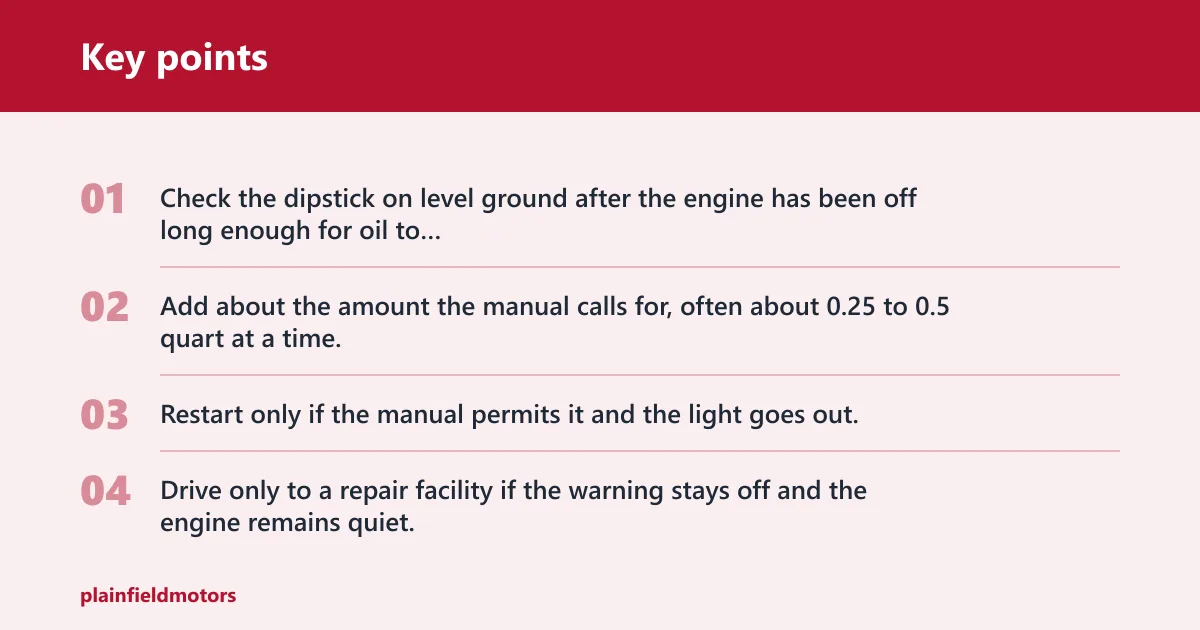
When a top-up may be allowed
- Check the dipstick on level ground after the engine has been off long enough for oil to drain back.
- Add about the amount the manual calls for, often about 0.25 to 0.5 quart at a time, then wait a minute and recheck.
- Restart only if the manual permits it and the light goes out.
- Drive only to a repair facility if the warning stays off and the engine remains quiet.
When restart is not allowed
OilFinderPro advises not to restart if the engine is noisy after the warning appears. Knocking, ticking that gets louder, or a flashing red light points away from a simple low-level fix. A steady warning with normal oil level also deserves pressure verification, not repeated restarts.
How do you tell a sensor fault from real pressure loss?
A bad oil pressure sensor or wiring fault can trigger a false warning, but it still needs confirmation. A normal dipstick does not rule out low pressure. The same source says a full dipstick does not prove everything is okay, because the pump, filter, relief valve, or internal clearances can still be wrong.
Engine bearing clearance matters here. Wear inside the engine can let pressure bleed off even when oil is present. That is why a mechanic does not stop at the dipstick; the first checks usually include oil level, signs of leakage, filter condition, and an actual pressure test at the port for the sensor circuit.
What a technician verifies first
Suppose the dipstick reads normal, the red light is still on, and there is no puddle under the car. The next step is not another top-off. It is pressure testing and inspection of the sensor circuit, oil filter, oil pump, and signs of internal wear.
Common mistakes
The biggest mistake is driving with the light on because the car still moves. Another is treating the warning like an oil change reminder. A third is adding oil without checking the manual, which can overfill the crankcase and create new problems.
- Do not keep driving with a red oil pressure light on.
- Do not assume a yellow oil light means the same thing as a pressure warning.
- Do not restart after knocking starts.
- Do not ignore visible leaks, even if the dipstick is not empty.
- Do not use a sensor fault as proof that nothing is wrong.
Frequently asked questions
What to do if oil pressure warning light comes
Pull over safely, shut the engine off, and check the owner’s manual before restarting. If the oil level is low and the manual allows a top-up restart, add oil in the specified amount and recheck. If the light stays on, call for a tow.
What should I do if the oil pressure warning light comes on while driving?
Get out of traffic, stop the vehicle, and shut the engine off immediately. The same source says red warning lights mean pull over as soon as it is safe. Do not continue driving to “see if it clears,” because true pressure loss can damage the engine fast.
Can you drive with oil pressure light?
No, not once it is a red pressure warning that stays on. A brief move to a safe stopping place is one thing; driving on it is another. If the engine is noisy, the risk is higher, and a tow truck is the safer choice.
Why did my oil pressure light come?
Common reasons include low oil level, a leak, oil pump trouble, a faulty sensor, or an after-service problem such as a loose filter or overfill. The symptom pattern matters. A normal dipstick, a knocking engine, or a flashing light changes the diagnosis.
What if the oil pressure warning light comes on after an oil change?
Check for a loose filter, drain plug leak, wrong filter, or overfill, then verify the dipstick only if the manual allows it. If the warning remains on after that, stop restarting. The next step is a service shop or dealer inspection.
How do I know if it is low oil or low oil pressure?
Use the dipstick to check level, but do not treat a normal reading as proof that pressure is fine. Low level can cause low pressure, yet pump failure, a bad sensor, or internal wear can leave the level looking normal. Pressure testing settles the question.