Why Is My Check Engine Light Flashing?

A flashing check engine light usually means a severe misfire, so lift off the throttle at once and stop driving if the engine shakes, smells like fuel, or loses power. Continuing can overheat the catalytic converter fast and turn a small repair into a much bigger bill. This guide explains the warning by symptom pattern and driving condition, then tells you when to pull over, tow, or do a quick roadside check.
Flashing CEL triage table
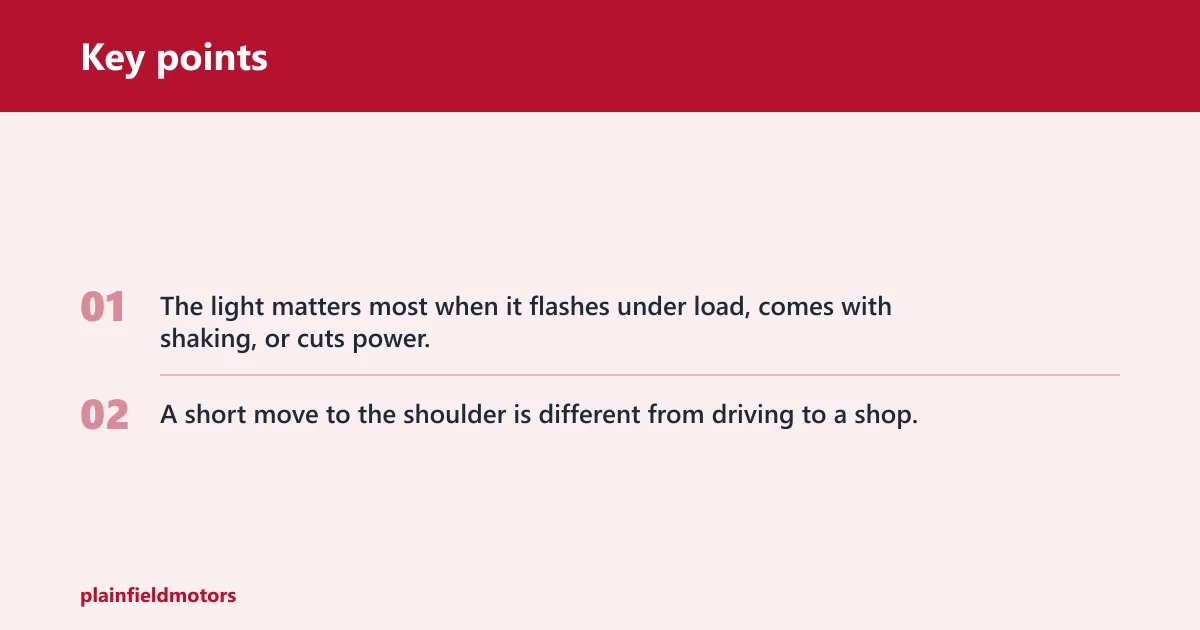
Use the symptom pattern first. The light matters most when it flashes under load, comes with shaking, or cuts power. A short move to the shoulder is different from driving to a shop, and that line is clear in the table below.
| flash behavior | drivability symptom | most likely systems | next safest action |
|---|---|---|---|
| Flashing at idle | Rough idle, light shaking, may clear when revved slightly | Ignition coil, spark plug, vacuum leak, fuel delivery | Stop if shaking is steady; otherwise move only a short distance and scan the codes |
| Flashing under acceleration | Loss of power, stumble, bucking on throttle | Misfire under load, coil failure, fuel pressure, injector flow | Ease off the accelerator and pull over safely |
| Flashing then stopping | Intermittent stumble or none at the moment | Intermittent misfire, pending code, loose connector, coil heat failure | Do not assume it is fixed; scan soon and avoid hard acceleration |
| Flashing with shaking | Noticeable vibration, rough running, possible fuel smell | Active engine misfire, spark plug, ignition coil, fuel delivery | Stop driving now and arrange a tow if the shake is strong |
| Flashing after spark plug replacement | Rough running right after service | Incorrect gap, loose coil connector, damaged boot, wrong plug, separate misfire | Recheck installation before more driving; scan for cylinder codes |
| Flashing with traction control light | May feel like reduced power or wheel slip logic cutting in | Engine misfire plus traction control intervention, shared sensor data, drivetrain protection | Do not let the traction light distract you; diagnose the engine fault first |
| Flashing only while climbing hills | Power drop under load, smooth at light throttle | Coil weakness, fuel pressure, injector flow, compression loss | Avoid hills and hard throttle; scan and inspect before further driving |
| Flashing then stays on | Misfire may have eased, engine still may run rough | Active fault may have become a stored or pending code | Slow down, minimize load, and schedule diagnosis soon |
| Flashing but no codes yet | Intermittent stumble, no light history on a basic scan | Pending code, intermittent misfire, early coil or fuel fault | Rescan after the event; use freeze-frame and pending data if available |
What does a flashing light mean?
A flashing check engine light, also called the Malfunction Indicator Lamp, points to an active engine or emissions fault rather than a routine reminder. In practice, a flashing CEL is more urgent than a solid one because repeated misfires can send unburned fuel into the catalytic converter.
Why the catalytic converter is at risk
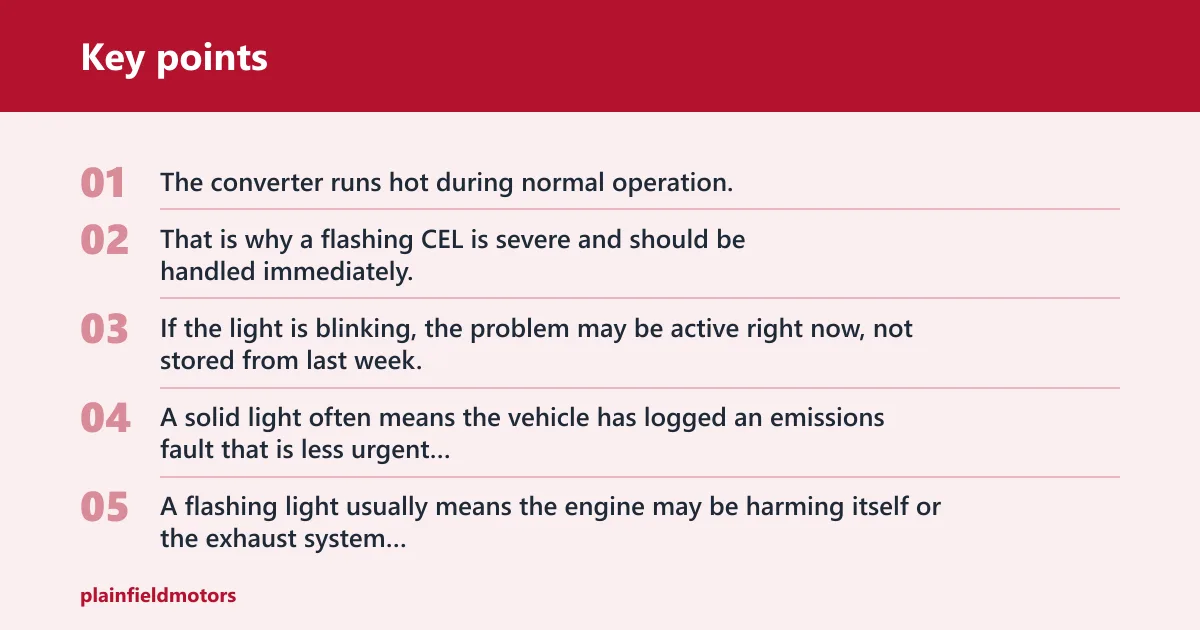
The converter runs hot during normal operation, and extra fuel can raise that heat quickly. That is why a flashing CEL is severe and should be handled immediately. If the light is blinking, the problem may be active right now, not stored from last week.
A solid light often means the vehicle has logged an emissions fault that is less urgent in the moment. A flashing light usually means the engine may be harming itself or the exhaust system while you keep driving.
What the MIL is telling you
The CEL is often described as the Malfunction Indicator Lamp, or MIL. That lamp is tied to engine and emissions systems, so treat the flash as a live fault signal rather than a generic sensor warning. A loose gas cap can light a solid CEL, but a flash deserves a different level of caution.
Why is my check engine light flashing while driving?
When the light flashes while driving, engine load is often part of the problem. A misfire may show up during acceleration, hill climbing, or steady highway pull, then ease off at idle or light throttle. That pattern matters because some faults only show up when the engine works harder.
Under load and acceleration
The most common cause of a flashing or blinking CEL is a misfiring engine. A coil may fail only under load, a spark plug may leak spark under higher cylinder pressure, or fuel pressure may fall when demand rises. That is why the car can feel fine at cruise and then stumble when you step into the throttle.
Low fuel pressure can also cause stumbling, misfire, or stalling. A weak pump, clogged injector flow, bad regulator, or restricted filter can starve the engine when it needs more fuel, which can show up first as a flash under acceleration and reduced power on a grade.
At idle or in stop-and-go traffic
A flashing CEL at idle can still be a misfire, but the pattern may be lighter and easier to miss. You may see a rough idle, slight shaking, or a stumble when you shift into gear. That does not make it safe to ignore if the flash is steady.
Picture a compact sedan that runs clean at 40 mph but starts flashing at every red light. That pattern points you toward ignition, vacuum, or fuel delivery faults that show up when cylinder filling and idle control are least stable.
When the light flashes and then stops
If the light flashes and then stops, the fault may be intermittent rather than gone. The vehicle may still have a pending code, a stored misfire history, or a coil that fails only when hot. Do not treat the light going off as proof that the problem is fixed.
A common first-timer mistake is assuming the warning ended because the dash looks normal again. The engine may still be on the edge of another misfire, especially after a hard pull, wet weather, or a hot restart.
Why is my check engine light flashing and the car shaking?
A flashing CEL and shaking car both point toward an engine misfire. If the shake is strong, power is dropping, or the engine sounds uneven, stop driving safely. That combination can send raw fuel into the exhaust and can damage the catalytic converter quickly. (Wikihow)
Misfire symptoms you can feel
Engine misfire is the most common flashing-light cause. It can be intermittent, and the symptoms often include shaking, rough idle, and loss of power. You may also feel hesitation when pulling away, a bucking motion at speed, or a brief surge followed by a stumble.
Suppose the car shakes hard enough that the steering wheel buzzes at idle and the flash starts as soon as you accelerate. That is not the time for a normal drive home. Pull over, shut the engine down if the shake is severe, and arrange a tow.
Loss of power and rough idle
Loss of power often tells you the misfire is not minor. The engine may struggle to climb a slight hill, refuse to accelerate normally, or feel flat above a certain throttle angle. Rough idle is another warning that the problem is affecting combustion in more than one cylinder.
Do not keep driving normally if the engine is shaking and power is dropping. The safest move is to reduce load at once, get to a safe spot, and stop if the symptoms stay active.
When to stop driving now
Stop driving now if the flash comes with strong shaking, a heavy fuel smell, loud popping, or a clear lack of acceleration. Those signs point to an active misfire that can be hard on the engine and exhaust system. A short move to the shoulder is different from trying to reach the next town.
- Lift off the throttle.
- Turn on hazard lights.
- Move to a safe shoulder or parking lot.
- Shut the engine off if the shake is severe.
- Plan for a tow if the car cannot run smoothly at idle.
Common causes to check first
Start with the easiest and highest-risk items first. Misfire diagnosis should begin with spark plugs, ignition coils, fuel delivery, and then compression if the first checks do not explain the flash. Replace parts only after a cause is identified.
Spark plugs and installation issues
Bad spark plugs are a common cause, and many maintenance schedules place replacement at about 100,000 miles on many vehicles. That is a common service interval, not a rule for every engine. The right move is to base replacement on diagnosis, plug condition, and the vehicle’s service schedule.
After spark plug replacement, a new flash can point to an installation issue, a coil problem, or a separate fault that was already there. Check plug gap, connector lock, coil boot seating, and whether the correct part number was installed.
Ignition coils under load
Faulty ignition coils are a common cause, and they can mimic bad spark plugs. A coil may work at idle and fail under load, which is why the flash often appears during acceleration or uphill driving first. That pattern helps separate coil trouble from a simple idle complaint.
Worn plugs and failing coils are both common reasons for flashing lights, and either can set a cylinder-specific code like P0301 or a random misfire code such as P0300. A scanner helps you see which cylinder, if any, is involved.
Fuel delivery faults
Fuel delivery problems can also cause the flash. Low fuel pressure, weak pump output, clogged injector flow, or a bad regulator can all reduce acceleration and make the engine stumble under load. A fuel fault can look a lot like ignition trouble from the driver’s seat.
If the engine loses speed when you ask for more throttle but smooths out when you back off, fuel supply deserves a close look. That is especially true if the light appears on hills or during passing maneuvers.
Compression problems
Low compression can cause a flashing CEL and points to a more serious mechanical issue. Rings, valves, a head gasket, or timing components can all reduce cylinder pressure enough to create a misfire. That is a different tier of repair from a simple tune-up item.
If compression is low, the misfire may persist after plug or coil replacement. That is why a flashing light with repeated misfire on the same cylinder should not be treated as a parts-swap problem.
What codes and scans can tell you
An OBD2 scanner or code reader is needed to narrow the cause. It can read diagnostic trouble codes such as P0300 for random misfire and P0301 for cylinder 1 misfire, plus pending codes that have not fully set the warning yet. A scan is the quickest way to move from guesswork to a useful direction.
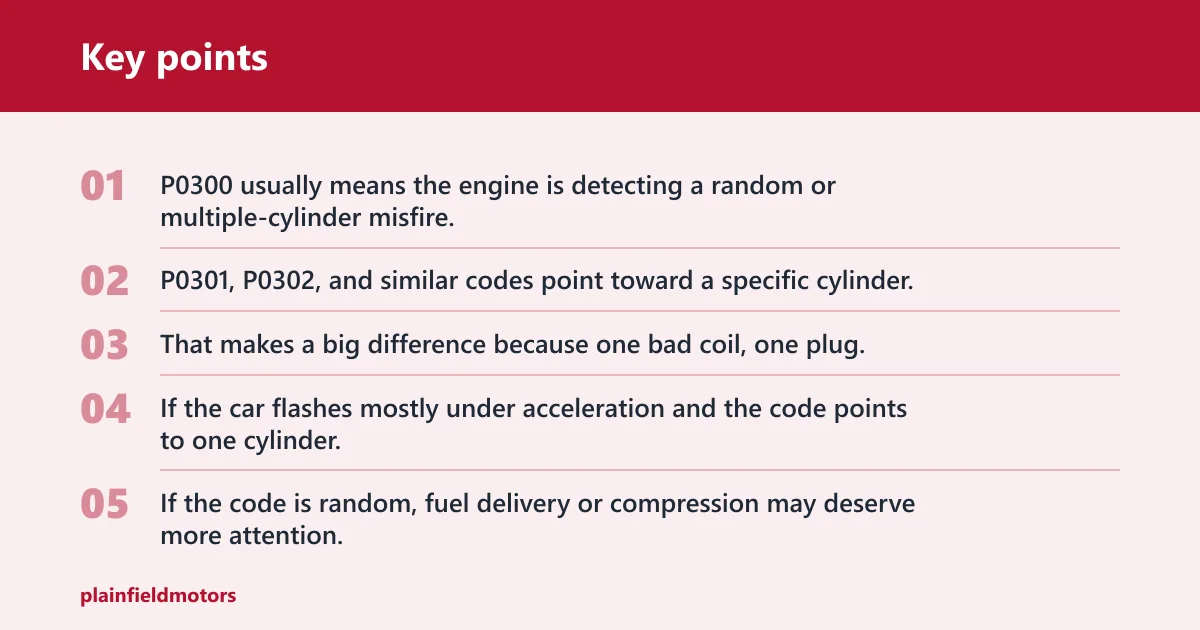
P0300 and cylinder-specific misfire codes
P0300 usually means the engine is detecting a random or multiple-cylinder misfire. P0301, P0302, and similar codes point toward a specific cylinder. That makes a big difference because one bad coil, one plug, or one injector can be isolated faster than a whole-engine problem.
If the car flashes mostly under acceleration and the code points to one cylinder, check the plug and coil on that cylinder first. If the code is random, fuel delivery or compression may deserve more attention.
Why no stored code can still happen
A flashing CEL can occur with intermittent or pending codes, though it is not always limited to them. That is why a basic scan may show no stored code right after the event. The fault may have been active long enough to flash the lamp, but not long enough to lock in a permanent stored code yet.
Do not let “no codes” lull you into ignoring the symptom. If the engine shook, lost power, or flashed under load, the scan may need to be repeated after the next drive cycle or after a freeze-frame capture.
Pending codes and freeze-frame data
Pending codes tell you the computer saw a fault that did not mature into a full code. Freeze-frame data can show engine speed, load, coolant temperature, and vehicle speed at the moment the fault set. That helps separate an idle misfire from a load-related misfire.
Use the scan as a guide, not the final word. The symptom pattern still matters, especially when the code history is thin.
Frequently asked questions
Why is my check engine light flashing then stops?
A flash that stops usually means the misfire is intermittent, not cured. The engine may only stumble under load, at a certain temperature, or during a hot restart. Scan for pending and stored codes, then avoid hard acceleration until the cause is found.
Why is my check engine light flashing then stays?
If the light flashes and then stays on, the fault may have moved from an active severe misfire to a stored or less active problem. The engine still needs attention. Scan the codes, note whether the car is shaking, and avoid normal driving if power is still low.
Why is my check engine light flashing while driving: flashing while driving often points?
Flashing while driving often points to a misfire that appears under load. Common causes include spark plugs, ignition coils, and fuel pressure faults. If the flash starts during acceleration or uphill driving, ease off the throttle and get the car to a safe stop.
Why is my check engine light flashing and my traction control light?
The traction control light can appear alongside an engine complaint, but it should not distract from the misfire diagnosis. The engine fault may be causing reduced power or related drivability logic. Check the engine codes first, then sort out any traction-related follow-up.
Why is my check engine light flashing at idle?
A flash at idle often means the engine has an idle misfire, rough combustion, or a fault that shows up when airflow and load are low. Spark plugs, coils, and fuel delivery are still common checks. If the engine shakes at idle, stop driving instead of pushing on.
Why is my check engine light flashing after changing spark plugs?
After spark plug replacement, a new flash can mean the plugs were gapped wrong, a coil connector was left loose, or a coil boot was damaged. It can also mean the original problem was not the plugs at all. Recheck the installation before more driving.