Why Does the Battery Light Come on While Driving?

The battery light means the charging system has failed, so you can usually drive only a short distance to a safe stop if the engine still runs normally. Ignore it and the engine can quit, the steering may get heavy, and a restart may fail. This guide explains what the light means, when to keep going briefly, when to pull over, and when not to restart.
How warning-light symptoms change the response
Use the warning light with the rest of the symptoms, not alone. A steady light with normal operation is one road decision. A light plus dimming dash lamps, belt noise, steam, or stalling is another, and it changes whether you keep moving, pull over, or call for a tow.
| Symptom combination | Likely fault area | Urgency | Road decision |
|---|---|---|---|
| Light only, engine runs normally | Charging system, often alternator or wiring | High | Continue only to a safe stop or repair shop if no other symptoms appear |
| Dimming lights or weak electricals | Low charging output, battery reserve being used | High | Turn off loads and continue only to a safe stop |
| Belt noise with the warning light | Serpentine belt or alternator belt slip, looseness, or breakage | High to critical | Pull over now if noise is severe or charging drops fast; otherwise go straight to a safe stop |
| Burning smell with the warning light | Belt slip, overheated wiring, or charging component overload | Critical | Stop immediately and call for help |
| Overheating, steam, or temperature rise | Cooling or belt-driven accessory problem on some engines | Critical | Stop immediately |
| Rain or puddle trigger | Water on belt, pulley, or connector; possible belt contamination or intrusion | High | Continue only to a safe stop if the engine runs normally; inspect soon |
| Flashing or intermittent warning | Intermittent alternator, belt, wiring, or regulator fault | High | Limit driving and plan a safe stop quickly |
| Steering heaviness or sluggish assist | Battery reserve falling and some belt-driven systems dropping out | Critical | Pull over now |
| Stalling while driving | Charging failure has progressed to power loss | Critical | Stop immediately and do not keep driving |
| No-restart risk after stopping | Battery reserve already too low, alternator not charging | Critical | Call for tow and avoid restart unless you have confirmed charging recovery |
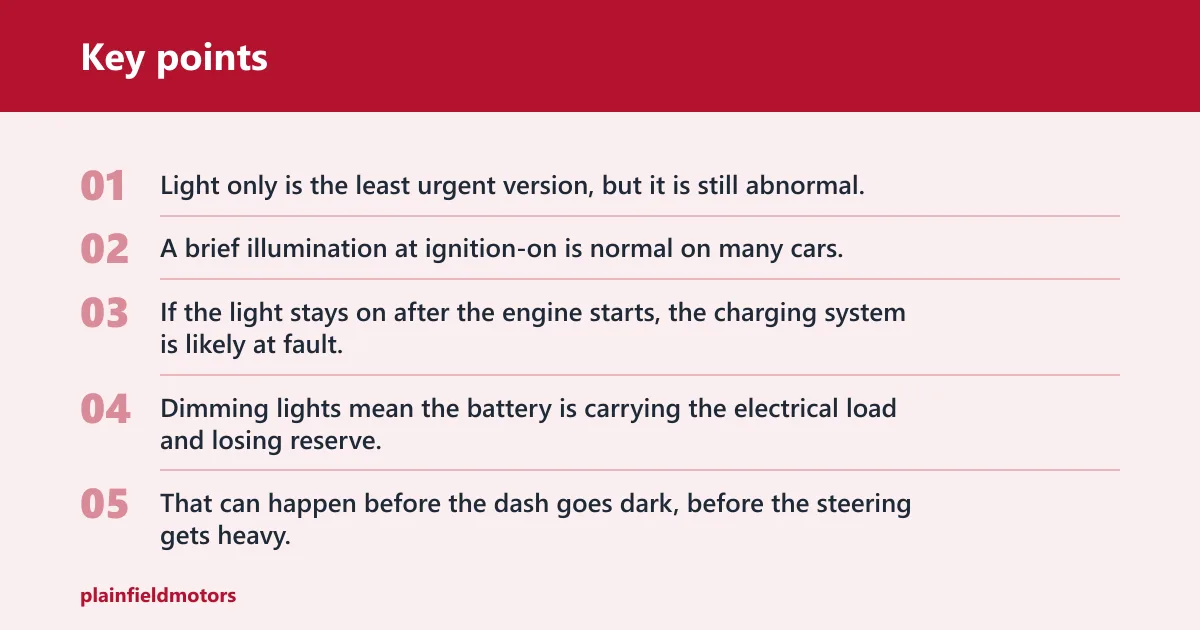
Light only is the least urgent version, but it is still abnormal. A brief illumination at ignition-on is normal on many cars. If the light stays on after the engine starts, the charging system is likely at fault, and continuing to drive can end with the engine stopping.
Dimming lights mean the battery is carrying the electrical load and losing reserve. That can happen before the dash goes dark, before the steering gets heavy, and before the engine stalls. If the dimming is obvious, treat it as a pull-over-now problem.
Belt noise or burning smell shifts suspicion toward the serpentine belt or alternator belt. One belt may drive the alternator and other important components on some engines, so a broken or slipping belt can create a charging warning and additional failures at the same time.
Rain or puddles deserve special attention. Water can make a worn belt slip, wash contamination onto pulleys, or expose a weak connector. If the light appears after a puddle splash or in heavy rain, do not assume the battery itself is the cause.
What the battery light means
The battery warning light usually signals a charging-system fault. The alternator is the main charging source once the engine is running, and if it is not charging, the battery has to power the vehicle alone until its reserve runs down.
Charging-system warning, not just battery condition
The battery icon is a charging-system warning light. It can point to the alternator, belt drive, wiring, or the voltage regulator, and the warning staying on while driving is abnormal. A new battery will not solve the issue if the alternator is not charging.
How the alternator, regulator, belt, and wiring fit together
The alternator makes the electrical power after the engine starts. The regulator controls charging output. The belt spins the alternator. Wiring and terminals carry that output to the battery and the rest of the car. A fault in any one of those parts can light the warning.
Why the meaning can vary by vehicle
Vehicle-specific warning behavior matters. Some makes and models use the same lamp for charging-system faults, while others may tie it to engine-management faults too. The handbook guidance for your specific car matters because the same light can mean different things across models.
Why is the battery light on while driving?
The most common reasons are alternator failure, belt trouble, terminal or cable resistance, and wiring or regulator faults. Rain can also trigger the light by slipping a belt or exposing water intrusion. The key question is not only what caused it, but how quickly the car may lose electrical reserve.
Alternator failure or low output
Could a bad alternator turn the battery light on while driving? Yes. That is the most common failure point, and it is the top cause many roadside guides list. If the alternator output drops, the battery light comes on because the battery is no longer being charged.
Serpentine belt slip, looseness, or breakage
Could a loose or broken belt cause the battery light to come on? Yes. A loose, worn, or broken serpentine belt or alternator belt can trigger the warning. On some engines, that same belt also drives other important components, which is why a belt fault can become more than a charging problem.
Battery terminal or cable resistance
Loose, corroded, or damaged battery terminals and cables can interrupt charging and mimic alternator failure. Inspection should include tightness and corrosion at the terminals, plus the cable ends and main charging wire. A bad connection can make the light come on even when the alternator itself is healthy.
Wiring or regulator faults
Wiring faults can mimic charging failure. The same is true for a bad voltage regulator. That is why parts should not be replaced by guesswork. The light is a clue, not a final diagnosis.
Water, dirt, or belt contamination after rain
Why did my battery light come on while driving in the rain? Water can reduce belt grip, splash debris onto pulleys, or expose a weak connector. If the light came on right after a heavy puddle or wash-down, belt contamination or water intrusion should be on the short list.
Say your sedan starts fine, then the battery light appears after a deep puddle on a wet road. If the dash stays bright and the engine sound stays normal, the next move is still a safe stop, not a long detour. The rain detail points toward belt slip or connector trouble, not a random battery failure.
Can you keep driving?
Yes, but only in a limited sense. If the engine still runs normally and there are no severe symptoms, you can usually drive a short distance to a safe stop while reducing electrical load. If the light is joined by dimming, steering heaviness, smoke, or stalling, stop now.
When to continue to a safe stop
Keep going only long enough to reach a safe shoulder, parking lot, or repair location if the car still feels normal. That means no strong belt noise, no burning smell, no overheating, and no growing electrical weakness. The clock is running once the light comes on.
What loads to switch off right away
Turn off nonessential electrical loads to preserve battery reserve. Start with the A/C, high-power audio, and heated accessories. If the car has extra lighting or convenience loads that are not needed for the drive, shut those off too. This can stretch reserve power long enough to reach a safe stop.
When to pull over immediately
Pull over immediately if the steering gets heavy, the engine starts to stumble, the battery icon flashes rapidly, or you smell burning. Dimming lights, warning changes, or any sign of stalling means the battery reserve is being depleted fast and the next mile may be too far.
What symptom means you should not keep driving
Do not keep driving if the engine stalls, if the temperature climbs, or if the car loses major electrical assist. That is not a “watch and wait” situation. Continuing to drive can end with the engine stopping and the vehicle becoming hard to steer or restart.
What to do right away
Act as if the charging system may stop working completely. Reduce load, listen for belt noise, watch the dash, and make a quick decision about safe stopping. The goal is to preserve battery reserve and avoid a dead restart at the worst possible place.
Turn off nonessential electrical loads
Start with A/C, heated seats, heated rear glass, and the radio if they are not needed. If night driving is involved, keep the lights on, but cut everything else you can safely live without. That simple load shedding can buy time.
Check for belt noise, smoke, or heat
If you hear squealing, chirping, or grinding from the front of the engine, the belt or a pulley may be involved. If you smell rubber or see smoke, stop immediately. Heat or smoke around the belt area is a stronger warning than the battery light alone.
Watch for dimming lights or warning changes
Monitor the headlamps, instrument cluster, and power steering feel. A flashing or intermittent battery light can be a sign of a fault that is changing while you drive. If the warning gets worse, the safe choice is to stop sooner rather than later.
How the fault gets checked
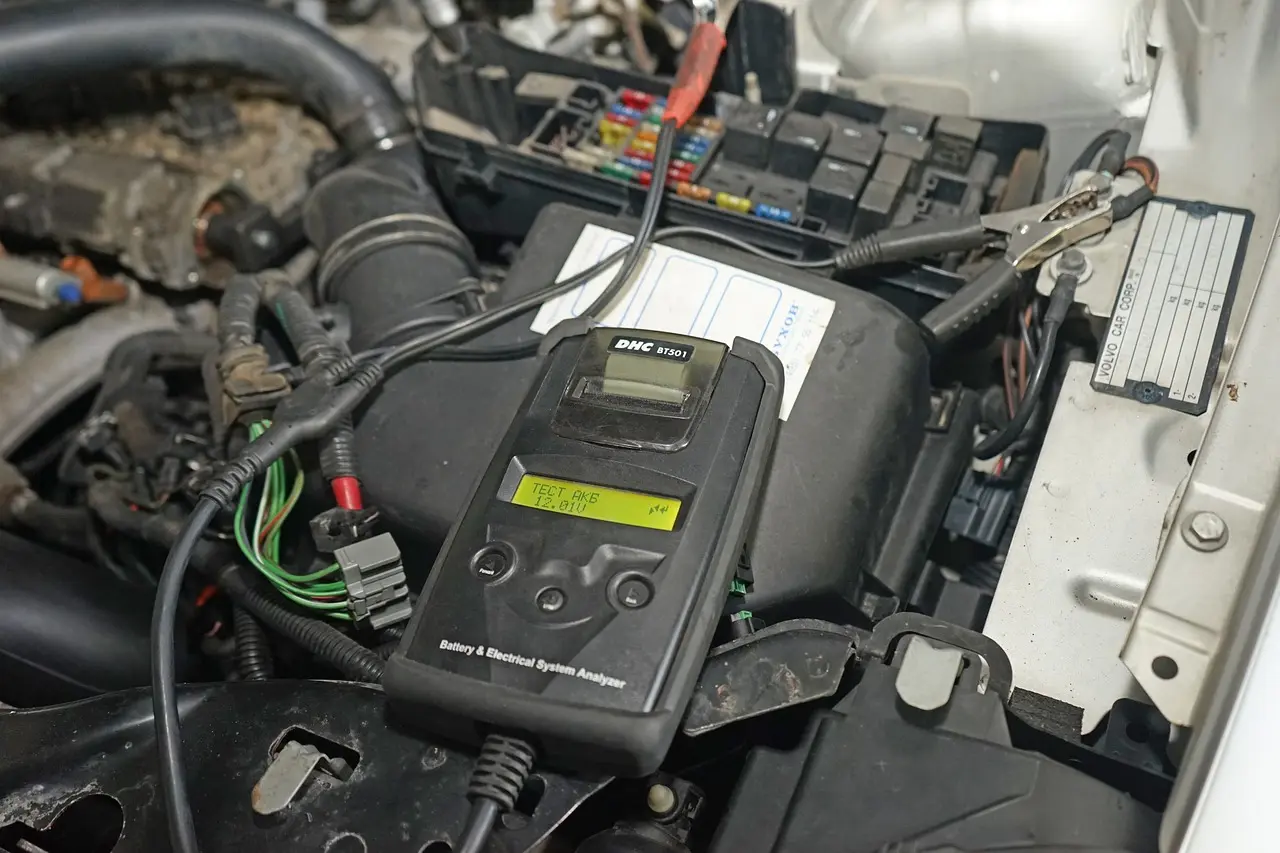
Diagnosis should include voltage before and after starting. It should also include voltage under load. Those checks help separate a bad alternator from a weak battery, a bad connection, or a belt issue, and they keep you from replacing parts that are still good.
Voltage testing before and after starting
A proper check starts with battery voltage before the engine starts and again after the engine is running. That tells you whether the system is charging at all. If the voltage does not rise after starting, the charging system is not doing its job.
Load and charging checks
Voltage under load matters because a weak system can look acceptable with no accessories on. Headlights, blower motor, rear defogger, and other loads can reveal a failure that a no-load test hides. That is why load testing belongs in the diagnosis.
Inspecting the belt, pulleys, terminals, and cables
The inspection should look at belt condition, tension, pulley alignment, terminal tightness, cable corrosion, and damaged wiring. On some engines, one belt drives multiple systems, so a belt fault may affect more than charging. If the belt is broken or slipping, the fix is different from an alternator replacement.
Why parts should not be replaced by guesswork
A new battery will not solve the issue if the alternator is not charging. Replacing the wrong part costs time and money and can leave the real fault untouched. Diagnosis first, parts second, is the safer path.
| Likely fault area | What to check first | Common repair direction |
|---|---|---|
| Alternator | Charging voltage before and after starting | Alternator replacement or electrical repair |
| Serpentine belt / alternator belt | Belt condition, tension, pulley condition | Belt replacement, tensioner or pulley service |
| Battery terminals and cables | Tightness, corrosion, cable damage | Cleaning, tightening, cable or terminal repair |
| Wiring or regulator | Charging circuit and connector checks under load | Wiring repair, regulator or control repair |
OBDadvisor says the clock is running once the light comes on. They estimate reserve driving time as minutes to about an hour, but that is only a rough window. Load, battery health, temperature, and the exact fault can shorten it fast.
Suppose a compact car shows the battery light at highway speed, then the headlights begin to dim and the radio cuts out. That is not a “maybe later” pattern. The battery reserve is being spent, and the smart move is to reach the nearest safe stop with as few loads as possible.
Will it restart later?
Maybe, but you should not count on it. If the alternator is not charging, the battery may have enough reserve to keep the engine running for a while and still be too weak to restart after shutdown. Stalling makes the risk much worse.
Why low reserve can leave the car dead after shutdown
Once the engine stops, the alternator stops too. If the battery has already been drained by driving with a charging fault, the starter may not have enough power for another crank. That is why a car can seem drivable right up to the point where it will not start again.
Signs the battery may not have enough charge left
Slow cranking, dim interior lights, weak power windows, and a dash that fades when you stop are warning signs. If those show up, treat the car as a no-restart risk. Do not switch it off just to see what happens unless you are already at your stop.
Why stalling changes the risk level
Stalling means the electrical reserve has already failed to support engine operation. If the car stalls in traffic, restart confidence is low until the charging system is checked. Tow it rather than risk repeated dead starts or another stall in a bad location.
Frequently asked questions
Why does the battery light come on while driving?
It usually means the charging system is not keeping up. The alternator may have stopped charging, a belt may be slipping, or wiring or terminal resistance may be interrupting the circuit. If the light stays on after the engine starts, the problem is not normal.
What does it mean when the battery light comes on while driving?
It means the battery warning light is acting as a charging-system warning. The battery icon is not only about battery condition. It can point to the alternator, belt drive, wiring, or regulator, and the engine may stop if the fault continues.
Can I keep driving if the battery light comes on while driving?
Only briefly, and only if the car still runs normally with no dimming, smoke, heavy steering, or stalling. Turn off nonessential loads and aim for a safe stop. If the warning worsens, do not keep going.
Why would the battery light come on in my car while driving?
The most common causes are alternator failure, a loose or broken serpentine belt, battery terminal or cable problems, or wiring faults. Rain can also trigger the warning if water causes belt slip or exposes a weak connection. Vehicle-specific guidance matters too.
Why does my battery light come on and off while driving?
An intermittent light often points to a loose connection, a belt that slips only under certain conditions, or an alternator fault that comes and goes. Treat it as serious even if it clears for a moment, because the charging system may be failing in cycles.
What should I do right away if the battery light comes on while driving?
Turn off A/C, heated accessories, and other nonessential loads. Listen for belt noise, watch for dimming lights or a changing warning, and decide whether you can reach a safe stop. If the car stalls, overheats, or loses steering assist, stop immediately.