What Is Transmission Fluid for in a Car?

Transmission fluid lubricates gears and bearings, cools internal parts, and provides hydraulic pressure for shifting in many automatic transmissions. Ignore it, and you can get slipping, harsh shifts, overheating, and costly transmission damage. This guide explains what each function does, which part it protects, and the warning signs you can notice.
What transmission fluid does
Transmission fluid is commonly described as doing three main jobs inside the transmission: it reduces friction between moving parts, carries heat away from internal components, and in many automatic transmissions it helps create the hydraulic pressure that applies clutches and bands. The exact job depends on the transmission design, so the fluid must match the system the vehicle was built with.
Lubrication and wear control
Transmission fluid is a slippery liquid that coats moving parts inside the transmission. That matters for gears, bearings, and clutch packs, because the fluid film helps limit metal-to-metal contact and wear. If lubrication breaks down, drivers often notice noise, rough engagement, or a transmission that starts shifting less smoothly.
Heat control in automatic transmissions
Automatic transmission fluid also acts as a coolant. Heat damages transmission fluid quickly, and overheated fluid loses the protection that keeps seals, clutches, and other internal parts working as intended. When cooling falls short, the warning signs usually include delayed shifts, slipping, or a burnt smell after heavy driving.
Hydraulic function in automatics
In many automatic transmissions, fluid does more than cool and lubricate. It also transmits hydraulic force through the valve body and other passages so the transmission can shift. If that hydraulic control is weak because the fluid is low, wrong, or degraded, the result can be flare on shifts, hard shifts, or no-drive complaints in severe cases.
Transmission fluid function map
This table ties each fluid job to the part it affects, the symptom drivers usually notice when it fails, and the fluid family or specification group that commonly applies. The exact requirement still depends on the vehicle listing, especially for automatic, CVT, and DCT applications.
| Fluid job | Component involved | Failure symptom if neglected | Likely fluid type or spec family |
|---|---|---|---|
| Lubricates moving parts | Gears, bearings, bushings | Whining, rough operation, accelerated wear | ATF, manual gear oil, CVT, DCT |
| Carries heat away | Transmission case, clutch packs, fluid passages | Overheating, slipping, burnt fluid smell | ATF, CVT, DCT |
| Creates hydraulic pressure for shifting | Valve body, solenoids, clutch pistons | Harsh shifts, delayed engagement, slipping | Automatic transmission fluid, Dexron, Mercon |
| Protects clutch friction surfaces | Clutch packs and bands | Shudder, flare, poor gear engagement | ATF with the correct friction profile |
| Supports synchronizer action | Synchronizers and gear cones | Hard shifting, gear clash, notchy lever feel | Manual transmission fluid, gear oil, sometimes motor oil |
| Fits vintage friction behavior | Older automatic clutches and valves | Shift feel that does not match the design | Type-F automatic transmission fluid |
How fluid differs by transmission type
Automatic and manual transmissions usually need different fluids because they use different parts and different friction behavior. Automatic transmission fluid is typically thinner than manual transmission fluid, and manual transmission fluids are generally thicker than ATF. CVT and DCT units often need specialty fluids, so the label on the bottle matters less than the exact vehicle listing.
Automatic transmission fluid
Automatic transmission fluid, or ATF, lubricates moving parts, acts as a coolant, and helps transmit power hydraulically in automatic setups. It needs the manufacturer-specific specification for the vehicle, because the friction characteristics and additive package must match the transmission design. Some automatic fluids are identified by families such as Dexron or Mercon, while others call for a dedicated CVT or DCT fluid.
Manual transmission fluid
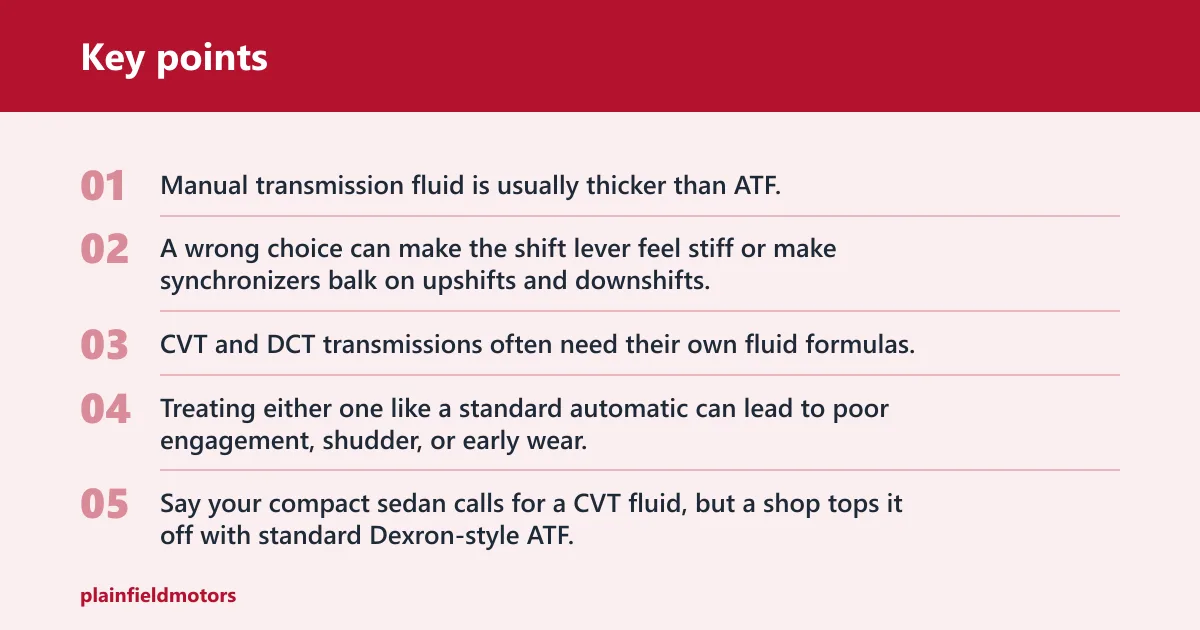
Manual transmission fluid is usually thicker than ATF. Depending on the design, it may be gear oil or motor oil, and it is chosen to protect gears and synchronizers rather than provide the same hydraulic behavior used in an automatic. A wrong choice can make the shift lever feel stiff or make synchronizers balk on upshifts and downshifts.
CVT and DCT fluids
CVT and DCT transmissions often need their own fluid formulas. Those fluids are built for the belt or chain behavior in a CVT, or the clutch and control requirements in a dual-clutch transmission. Treating either one like a standard automatic can lead to poor engagement, shudder, or early wear.
Say your compact sedan calls for a CVT fluid, but a shop tops it off with standard Dexron-style ATF. The car may still move, but it can develop shudder at light throttle and an odd, droning feel under load because the fluid’s friction behavior is wrong for the transmission design.
What happens when the wrong fluid is used?
The wrong transmission fluid can create shift problems fast. A mismatch can change friction, viscosity, and hydraulic response, which shows up as delayed engagement, harsh shifts, slipping, shudder, or added heat. It can also shorten the life of clutches, synchronizers, seals, and valve body parts.

Shift quality problems
Shift complaints are often the first clue. If the fluid does not match the transmission, the vehicle may hesitate before moving, shift too hard, flare between gears, or hunt for the right gear. Those symptoms point to poor hydraulic control or the wrong friction behavior, not just a dirty fluid appearance.
Heat and wear risks
Old or wrong fluid can cause wear and performance issues because it no longer protects the parts that depend on it. In an automatic transmission, the fluid can no longer manage heat as well, and that extra heat accelerates clutch wear and seal hardening. In a manual, the wrong fluid can leave gears and synchronizers less protected than they should be.
Why spec match matters
Color alone is not enough. Automatic transmission fluids can be green or red for identification, but the correct specification matters more than the color you see on the dipstick or in a drain pan. A vehicle-specific listing or owner’s manual is the only reliable way to match the fluid to the transmission.
Suppose a driver sees red fluid and assumes every red ATF is interchangeable. A late-model automatic may require one formula, while an older unit may need a different friction profile. The color still looks right, but the transmission may shift badly because the specification does not match.
Which fluid spec does your car need?
Start with the owner’s manual or the manufacturer’s listing for your exact model. That matters more than the bottle color, brand, or a generic name on the shelf. If the listing calls for Dexron, Mercon, Type-F, CVT fluid, DCT fluid, gear oil, or motor oil, follow that requirement instead of guessing from the transmission style alone.
Dexron, Mercon, and type-F
Dexron and Mercon are specification families used for some automatic transmission fluids. Dexron VI is an automatic transmission fluid specification, and older Dexron II D, Dexron III G/H, and similar variants may be superseded depending on the application. Mercon appears in several vehicle requirements, and Mercon V compatibility claims can matter for some older service fills. Type-F is an older automatic transmission fluid with no friction modifiers, so it is used only where that behavior is called for.
When “transmission oil” means something different
Transmission oil and transmission fluid are sometimes the same idea in casual conversation, but the term depends on the transmission design. In a manual gearbox, people often say gear oil or transmission oil. In an automatic, the correct term is usually ATF. The label on the bottle should match the vehicle requirement, not just the words used at the parts counter.
How to choose the right fluid
Check the vehicle listing. Use the owner’s manual or the manufacturer’s listing for your exact year, engine, and transmission. If the car has a CVT or DCT, look for that specific fluid family instead of standard ATF.
Match the specification family. Confirm whether the listing calls for Dexron, Mercon, Type-F, CVT fluid, DCT fluid, gear oil, or motor oil. The correct family is more important than fluid color.
Confirm service details. If the transmission has no user dipstick, the fill and level check may require a temperature-based procedure. That is normal on many modern automatics and helps prevent an overfill or underfill error.
Transmission service basics
Transmission service may include fluid replacement, and in some cases a flush, depending on the vehicle and the transmission design. A service can also include a filter change when the design calls for it. Cooler lines, the torque converter, and the fluid level check method all matter because the service touches more than the pan.
Fluid replacement and flushes
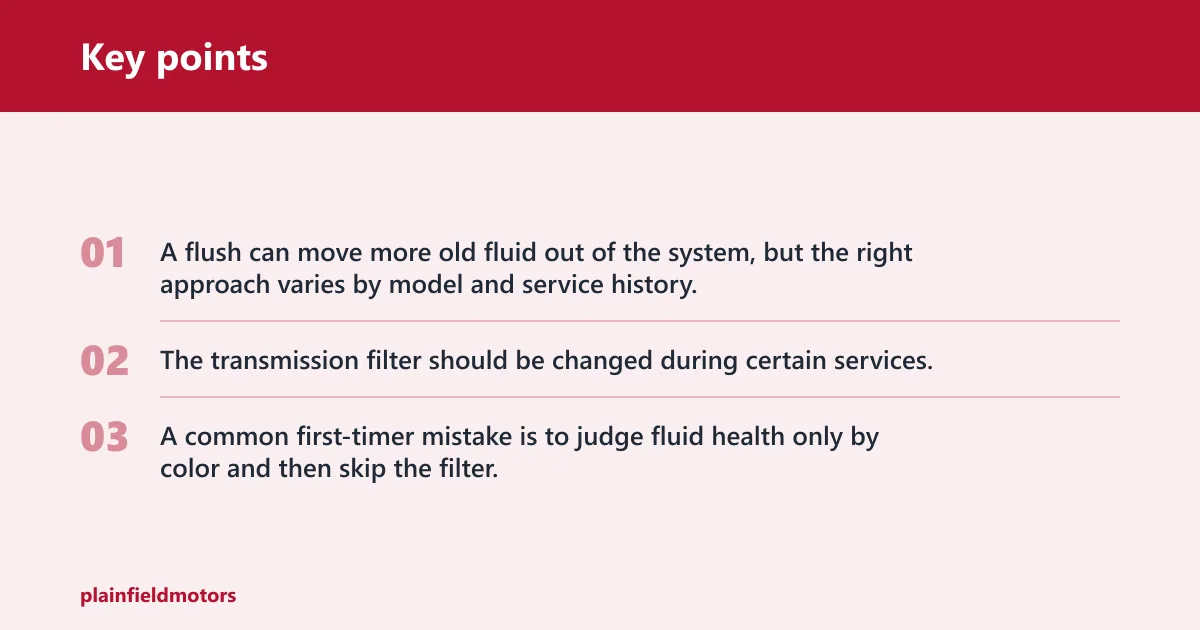
A drain-and-fill replaces part of the fluid. A flush can move more old fluid out of the system, but the right approach varies by model and service history. The key point is that transmission service is not one universal procedure, and the owner’s manual should guide what is safe for the vehicle.
Transmission cooler and torque converter
Automatic transmissions use a cooler to help control temperature, and that cooler can be flushed with the transmission system when the service calls for it. The torque converter also stores transmission fluid in automatic setups, so old fluid can remain there after a simple drain. That is one reason some service procedures replace more than the pan contents.
Filter changes
The transmission filter should be changed during certain services. Its job is to help keep debris out of the hydraulic system, which supports better pressure control and steadier performance. If the filter is restricted, the transmission may develop delayed engagement or inconsistent shifting even if the fluid still looks acceptable.
A common first-timer mistake is to judge fluid health only by color and then skip the filter. A dark pan does not prove a clogged passage by itself, but debris and varnish can restrict flow and reduce hydraulic performance. That is why the service procedure matters as much as the fluid choice.
Frequently asked questions
What is transmission fluid for in a car?
Transmission fluid reduces friction, moves heat away from internal parts, and in many automatics provides the hydraulic pressure that makes shifting possible. It protects gears, bearings, clutches, and valves. If the fluid is low, old, or wrong, the driver may notice slipping, harsh shifts, noise, or overheating.
What is transmission fluid made of?
Transmission fluid is a packaged lubricant with a base fluid and additives that control friction, wear, oxidation, and heat behavior. The exact formula depends on the specification family, such as Dexron, Mercon, CVT, DCT, or Type-F. That is why two red fluids on the shelf may not be interchangeable.
What does transmission fluid do in an automatic transmission?
In an automatic transmission, fluid lubricates moving parts, cools the unit, and helps transmit power hydraulically through the valve body and clutch circuits. It also supports torque converter function and clutch application. When it fails, the usual signs are delayed shifts, slipping, shudder, or heat-related wear.
Does a standard transmission have fluid?
Yes. A standard, or manual, transmission uses fluid too. It is often thicker than ATF and may be gear oil or motor oil depending on the design. Its main job is to protect gears and synchronizers, so the correct fluid choice affects shift feel and part life.
What transmission fluid for automatic should I use?
Use the exact fluid listed for your vehicle, not a generic “universal” answer. Many automatics require a specific Dexron, Mercon, or manufacturer-approved ATF, while others use CVT or DCT fluid. If the manual or listing is unclear, confirm by VIN or transmission code before topping off or servicing.
Can the wrong transmission fluid cause transmission problems?
Yes. The wrong fluid can create shift quality problems, extra heat, seal wear, clutch shudder, or poor engagement. That risk is highest when the transmission depends on a specific friction profile or hydraulic response. Matching the spec matters more than matching the color.