How to Make a Car Maintenance Checklist by Mileage

Build a mileage-based maintenance checklist from the owner’s manual, then sort each item into overdue now, due soon within about 1,000–2,000 miles, or monitor. Skip that process and you can miss fluids, wear parts, and service that costs more the longer you wait. This guide shows how to turn any manual into a priority-based plan you can actually use.
Start with the owner’s manual
The owner’s manual is the source of truth. Use it before any generic mileage chart, because service intervals change by make, model, engine, transmission, and driving conditions. Start your checklist with the factory schedule, then add time-based items and severe-use notes where the manual calls for them.
Find the maintenance schedule section
Look for the maintenance schedule, severe-service section, and any notes tied to the engine or transmission. Some manuals list services by mileage only, while others split items by mileage and time. Record the exact interval as written, even if it differs from common charts.
Note mileage and time together
Do not treat mileage as enough for every item. Brake fluid, battery age, tire age, and coolant service often depend on both distance and time. If the manual gives both, use the earlier trigger. That keeps the checklist useful when the odometer is low but the car is aging.
Record model-specific details
Write down anything that changes the schedule for your exact vehicle: engine code, transmission type, all-wheel drive, turbocharging, towing package, and climate guidance. Timing belts and timing chains are a good example. Some engines use a belt, others use a chain, and the checklist needs to reflect which one your car has.
What goes on a mileage checklist
A useful checklist tracks core mileage items, time-based items, and the source for each entry. It should also separate safety-critical work from items that are only coming up. That way you can act on what matters now instead of treating every line the same.
Core items to track by mileage
Include oil and oil filter service, tire rotation, inspections, fluid checks, brake service, filters, and belt checks. Many manufacturers place oil and filter service and tire rotation in the 5,000-7,500-mile range. Those items form the backbone of the checklist.
Add time-based items that do not follow mileage alone
Brake fluid often appears at every 30,000 miles or every 2-3 years when the manufacturer specifies it. Battery life is typically 3-5 years, so age matters even if mileage is low. Tires may need replacement at 2/32 inch tread depth or around 6 years of age.
Separate safety items from convenience items
Put brakes, tires, steering, suspension, and critical fluids in the highest-priority bucket if records are missing or the manual says the item is due. Cabin filters, appearance items, and some comfort checks can wait unless the manual ties them to a mileage milestone. The checklist should make that difference obvious.
Mileage checklist builder
Use this worksheet as a planning aid, not as a substitute for the manual. Fill one row for each service item you find in the factory schedule, then mark it overdue now, due soon, or monitor. If records are missing, start with the items that affect safety or known wear points first.
| Mileage interval | Service item | Source in owner’s manual | Time-based override | Priority (now/soon/watch) | Notes for severe-use adjustments |
|---|---|---|---|---|---|
| Every 5,000-7,500 miles | Oil and oil filter | Maintenance schedule | By time if the manual adds it | Now if overdue; soon if near interval | Short trips, towing, dust, heat, stop-and-go, or commercial use may shorten the interval |
| Every 5,000-7,500 miles | Tire rotation and inspection | Tire maintenance section | Inspect sooner if tread or wear is uneven | Soon if rotation is near | Severe use can call for more frequent inspection |
| About 30,000 miles | Filters, brakes, fluids, inspections | 30,000-mile service page | Brake fluid may also be time-based | Watch or soon depending on manual | Some vehicles add spark plugs here |
| About 60,000 miles | Transmission fluid, coolant, belts, timing belt check | 60,000-mile service page | Use time if listed before mileage | Soon if due window is close | Model-dependent; not universal |
| About 90,000 miles | Brake fluid, suspension, timing chain check | 90,000-mile service page | Follow time override if specified | Watch if only an inspection item | Some vehicles list a check, not replacement |
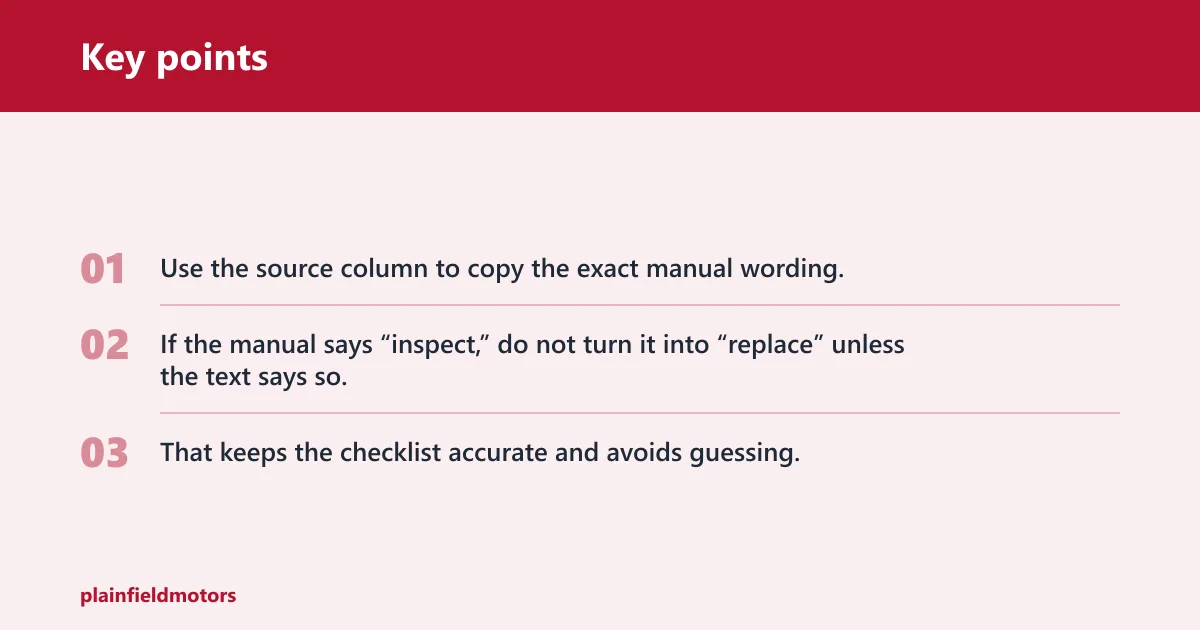
Use the source column to copy the exact manual wording. If the manual says “inspect,” do not turn it into “replace” unless the text says so. That keeps the checklist accurate and avoids guessing.
Which services are due every 5,000 to 7,500 miles?
Oil and oil filter service, tire rotation, and basic inspection items commonly sit in the 5,000-7,500-mile range. Some manufacturers allow up to about 10,000 miles with full synthetic oil, but that remains a manual-specific decision. Use the vehicle’s schedule, not a generic one.
Oil and oil filter
Oil and filter service is the repeating item most owners place at the top of the checklist. Many schedules use the 5,000-7,500-mile range. If your manual gives a longer interval with full synthetic oil, keep that exact number in the checklist and note the oil type beside it.
Tire rotation and inspection
Tire rotation is also commonly recommended every 5,000-7,500 miles. Add tread, pressure, and wear-pattern checks to the same line. That keeps the rotation from becoming a stand-alone reminder with no inspection attached.
Basic fluid and belt checks
At this interval, some manuals call for checking engine coolant, washer fluid, power steering fluid where applicable, and visible belt condition. Do not assume every fluid belongs here. Put only what the manual lists for your model.
Picture a sedan with 68,000 miles, a recent oil change, and uneven front tire wear. The checklist should move tire rotation and inspection into “soon,” even if the oil is current, because the tire item is the one tied to the wear pattern.
What should I include in a mileage-based maintenance checklist
Include mileage items, time-based items, the manual source, and a priority label for each line. That gives you a plan you can use when records are missing, when the car is aging, or when a service window is close. Safety-critical items should be easy to spot first.
What belongs on the list
Your checklist should include oil and filter service, tire rotation, brakes, fluids, filters, battery testing, belts, spark plugs where applicable, coolant service, and suspension checks. Add only the items that appear in the manual or in the severe-service section.
How to label priority
Use three labels only: overdue now, due soon, and monitor. Overdue now means the item is past the manual’s mileage or time point. Due soon means the item is within about 1,000–2,000 miles, or within a relatively short time window. Monitor means it is not due yet, but the next interval should stay on the radar.
How to handle missing records
If the history is incomplete, assume nothing. Start with oil and filter service, tire rotation, brake fluid age, tire age, battery age, and any visible wear items. Then compare the odometer to the manual and mark anything that could already be past due as “now.”
Suppose you buy a used SUV with 94,000 miles and no service records. A timing belt check belongs on the list if the engine uses a belt, but the first priority is still the safety side: brakes, tires, fluid condition, and battery age. Unknown history means you plan conservatively.
What maintenance is usually due at 30,000 miles?
Thirty thousand miles is often a major checkpoint for filters, brakes, fluids, and inspection items. Some vehicles also list spark plugs at this stage, while others do not. The exact mix depends on the manual, so use the factory schedule line by line.
Common 30,000-mile items
Expect cabin or engine filters, brake inspection, fluid checks, and a broader walkaround of belts, hoses, and suspension components. Brake fluid is often tied to this milestone or to a time interval of every 2-3 years. Some manuals also place spark plugs here, especially on certain materials and engine designs.
How to mark optional items
If the manual says “inspect” or if the item appears only on some trims or engines, tag it as model dependent. That keeps a 30,000-mile line from becoming a false promise for every car. A checklist should tell you what applies, not what might apply to someone else’s vehicle.
How do you handle 60,000- and 90,000-mile items?
These are milestone services, not universal parts lists. At about 60,000 miles, manuals often call out transmission fluid, coolant, belts, and timing belt checks. At about 90,000 miles, some schedules return to brake fluid, suspension, and timing chain checks. The vehicle design decides what belongs.
What to expect at 60,000 miles
Transmission fluid, coolant, belts, and timing belt checks are common at this point, but not every vehicle includes all of them. Timing belt service is typically referenced from 60,000-100,000 miles, while many engines use a timing chain instead. The checklist should name the exact component your engine has.
What to expect at 90,000 miles
Some manuals bring back brake fluid, suspension inspection, and timing chain checks around 90,000 miles. A chain is not a scheduled replacement item on many engines, but it may be inspected for noise, stretch, or related wear. That is why the manual matters more than a generic chart.
Why these milestones are model dependent
A turbocharged engine, a different transmission, or a severe-use schedule can change what shows up at each milestone. One car may list spark plugs at 30,000 miles, another at 100,000 miles, and another later still. Never copy a 30k, 60k, or 90k list from a different model without checking the book.
How do severe driving conditions change the plan?
Severe service means the vehicle works harder than a normal commuting pattern. Short trips, towing, dust, heat, stop-and-go driving, and commercial use can shorten intervals to about twice as frequent or more. If the manual has a severe-service section, use it from the start.
How to spot severe use
If the vehicle often runs short distances, idles in traffic, tows, works in dusty air, or sees hot climates and heavy loads, severe service likely applies. That does not mean every item changes, but it does mean the manual’s shorter interval becomes the one to use.
How to flag severe-use items
Mark any affected line with a note such as “severe-use interval” or “shorter interval per manual.” Then move the priority earlier if the shorter interval is close. This is especially useful for oil, tire rotation, fluids, and filter service.
How to combine mileage and time
Use whichever comes first. Brake fluid may be due by mileage or by age. Battery testing should happen yearly, and battery replacement often falls within an approximate 3- to 5-year life window. Tire replacement can come from tread depth, age, or both. Mileage alone will miss those items.
Frequently asked questions
How do I make a car maintenance checklist by mileage?
Start with the owner’s manual, list every service item by its exact mileage or time interval, then sort each one into overdue now, due soon, or monitor. Add the manual source, a time override, and severe-use notes so the checklist still works when records are missing.
Should I follow mileage only or mileage and time?
Follow both when the manual gives both. Mileage handles wear from use, but time matters for fluids, battery age, tire age, and brake fluid. Use the earlier trigger. That prevents you from waiting too long on items that age even when the odometer is low.
What items should be checked every 5,000 to 7,500 miles?
Oil and oil filter service, tire rotation, and basic inspections are the most common items in that range. Some manuals also call for belt, hose, and fluid checks. Use the exact maintenance page for your vehicle, because not every car assigns the same work to that interval.
What should I add for 60,000- and 90,000-mile services?
At 60,000 miles, add any transmission fluid, coolant, belt, and timing belt check items the manual lists. At 90,000 miles, add brake fluid, suspension, and timing chain checks if they appear in the schedule. These milestones are model dependent, so the factory schedule controls the list.
Can I use a printable mileage maintenance checklist
Yes. A printable checklist works well if it includes odometer reading, completed work, next due service, source in the owner’s manual, time override, priority, and severe-use notes. That format turns the schedule into a living record instead of a pile of reminders.
What maintenance should I track if my car has missing records?
Track the items that matter most first: oil and filter service, tire rotation, brakes, fluids, battery age, tire age, and any belt or timing component the manual calls out. If prior service is unknown, mark anything near the manual’s limit as overdue now until you can verify it.